




From Lone Wolves to Wolf Packs
For a long time, space missions were built around 'monolithic' satellites. These are large, incredibly complex, and expensive machines designed to do everything by themselves. Think of a single, brilliant journalist sent to cover a massive global event.
While capable, they can only be in one place at one time. This approach has significant drawbacks. A single point of failure—a malfunctioning sensor or a communication glitch—can jeopardise the entire multi-million or even billion-dollar mission. Furthermore, a lone satellite provides only a snapshot of a phenomenon, like a hurricane or a solar flare, from one specific angle at one moment in time.
The Power of Many
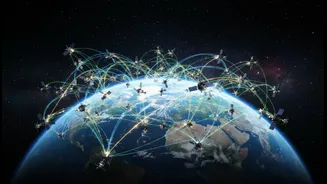
NASA's multi-satellite approach, often referred to as 'distributed systems' or 'constellations', changes this dynamic entirely. Instead of one huge satellite, a mission might use a group of smaller, often identical, spacecraft working in concert. Imagine sending a whole team of reporters to that global event. They can cover it from every angle, track developments as they happen in real-time, and if one reporter gets stuck in traffic, the story still gets filed. This is the core idea. By using multiple satellites flying in a specific formation, scientists can gather data simultaneously from different viewpoints. This provides a richer, more complete three-dimensional understanding of complex systems.
Real Missions, Real Discoveries
This isn't just a theoretical concept; NASA is already putting it into practice with remarkable success. A prime example is the Magnetospheric Multiscale (MMS) mission. Launched in 2015, MMS uses four identical spacecraft flying in a tight tetrahedral (pyramid) formation to study magnetic reconnection—a fundamental process that drives space weather and can impact our GPS and communication systems on Earth. By having four viewpoints, MMS can measure the structure and flow of energy through reconnection events in a way a single satellite never could. Another key mission is TROPICS (Time-Resolved Observations of Precipitation structure and storm Intensity with a Constellation of Smallsats). This constellation of small satellites, each about the size of a loaf of bread, provides rapid updates on tropical cyclones, with a median refresh rate of under an hour. This high-frequency observation helps scientists and forecasters better understand and predict how storms intensify.
More Science, Less Risk, Lower Cost
The benefits of this strategy are manifold. Firstly, it offers unprecedented temporal resolution, meaning scientists can observe how a system changes over minutes rather than hours or days. Secondly, it provides graceful degradation; if one satellite in a constellation of six fails, the other five can often continue the mission with minimal data loss. This redundancy significantly lowers mission risk. Thirdly, cost is a major driver. Building multiple smaller satellites using streamlined production methods is often cheaper than designing and launching one massive, custom-built spacecraft. They are also lighter, allowing them to be launched more affordably, sometimes as part of a rideshare with other payloads.
The Future is Autonomous and Collaborative
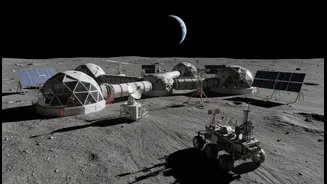
The next frontier for these satellite swarms is greater autonomy. NASA's Distributed Spacecraft Autonomy (DSA) project is developing software that allows these constellations to make decisions on their own with limited human intervention. Imagine a swarm of satellites observing a volcano that begins to erupt. An autonomous system could have the satellites reconfigure their orbits on the fly to get the best possible coverage of the event, all without waiting for commands from a ground station hundreds of miles below. This 'shared brain' approach will be critical for future missions, especially for sustained exploration of the Moon and Mars, where communication delays make direct control impossible.