
India’s Watchful Eye in Space
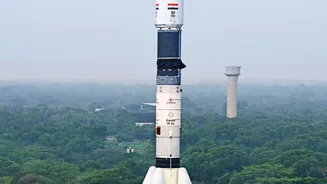
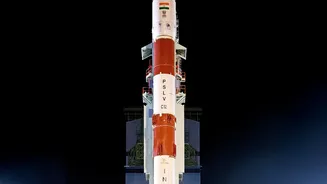
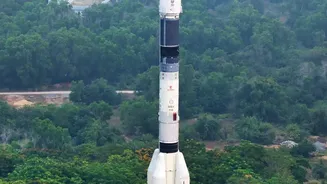
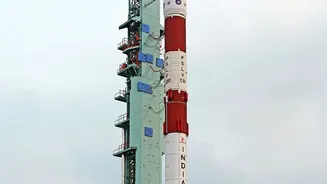
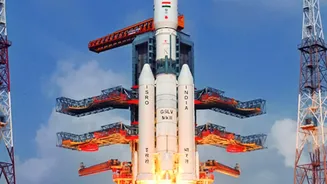
Launched in September 2023, Aditya-L1 is the Indian Space Research Organisation's (ISRO) first mission dedicated to studying the Sun. It is strategically positioned at Lagrange Point 1 (L1), about 1.5 million kilometres from Earth, giving it an uninterrupted
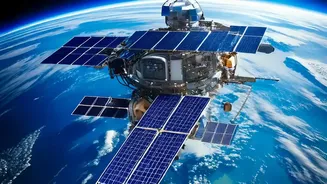
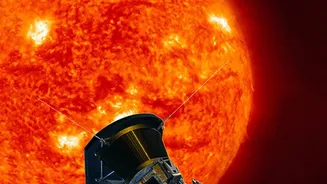
view of our star. The spacecraft is equipped with seven advanced instruments, or payloads, designed to observe the Sun's atmosphere—the photosphere, chromosphere, and the outermost corona—and to measure the solar wind and magnetic fields in its local environment. This dual capability of remote observation and in-situ measurement makes Aditya-L1 a uniquely powerful tool for solar science.
Decoding Solar Winds and CMEs
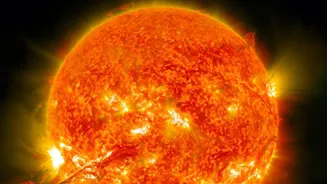
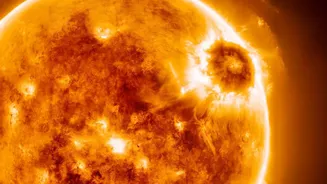
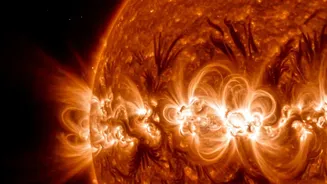
To understand Aditya-L1's discoveries, it's important to know what it's looking for. The 'solar wind' is a constant stream of charged particles flowing from the Sun, filling our solar system. A 'Coronal Mass Ejection' (CME), on the other hand, is a much more violent event—a colossal eruption of plasma and magnetic fields from the Sun's corona. While the solar wind is like a steady breeze, a CME is like a hurricane. When directed at Earth, CMEs can trigger geomagnetic storms that disrupt satellites, power grids, and communication systems, making their study crucial.
Solving an Earthly Magnetic Mystery
One of the most significant recent findings from Aditya-L1 helped explain a strange phenomenon observed on Earth during two intense geomagnetic storms in May and October 2024. During these events, ground-based magnetometers around the world registered sharp changes in Earth's magnetic field, as expected when hit by solar pressure changes. However, stations in the 'dawn' sector (the part of Earth rotating into sunrise) showed the exact opposite effect. Data from Aditya-L1's ASPEX instrument directly measured the solar wind pressure, confirming it was the driver of these disturbances. Scientists concluded that during very strong storms, powerful electric currents normally confined to the polar regions can dip down to lower latitudes, but primarily on the dawn side, causing this unusual magnetic reversal.
Catching Flares Before They Happen
In another major breakthrough announced in August 2026, data from three of Aditya-L1's instruments—SUIT, SoLEXS, and HEL1OS—revealed a potential early warning system for solar flares. Scientists discovered small, short-lived 'brightenings' in the Sun's atmosphere that appear hours before a major flare erupts, clustered around the same location. These transient events are believed to be small-scale energy releases that gradually destabilize the Sun's magnetic field, eventually leading to a massive explosion. This is a critical step towards developing reliable flare forecasting, which could give us vital hours of notice to protect our technology and astronauts.
The Power of a New Perspective
Aditya-L1's payloads are also providing a fresh look at CMEs themselves. The Plasma Analyser Package for Aditya (PAPA) has successfully detected the impacts of several CMEs, measuring the abrupt changes in electron and ion counts as the solar storm passes the spacecraft. Meanwhile, observations with the Visible Emission Line Coronagraph (VELC) have provided some of the closest-ever spectroscopic views of a CME lifting off from the Sun, allowing scientists to estimate its density and energy with unprecedented detail. By observing in wavelengths never used before for this purpose, such as near-ultraviolet light, the mission is providing entirely new datasets to understand the fundamental physics of these powerful solar events.