



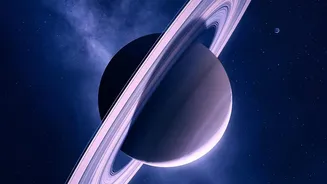
A Surprisingly Recent Arrival
For a long time, astronomers assumed Saturn’s rings were as old as the planet itself, having formed alongside it some 4.5 billion years ago. However, data gathered by NASA’s Cassini spacecraft during its final, daring dives between the planet and its rings in 2017
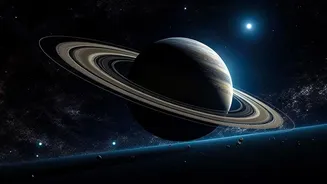
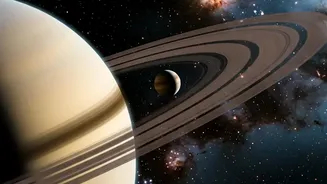
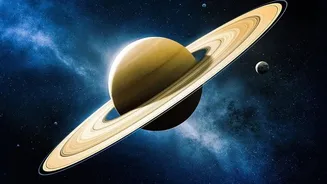
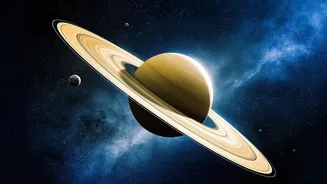
has upended this idea. By precisely measuring the mass of the rings, scientists determined they are remarkably lightweight. This low mass, combined with their composition of over 99% pure water ice, suggests they haven't been around long enough to be polluted by dark, dusty micrometeoroids. The current leading theory is that the rings are relatively new, likely forming just 10 to 100 million years ago—meaning they might have appeared during the age of the dinosaurs. New simulations suggest they could be the shattered remains of a hypothetical moon, dubbed Chrysalis, that strayed too close to Saturn and was torn apart by the planet's immense gravity.
The 'Ring Rain' Downpour
One of the most startling discoveries is that the rings are actively disappearing. Scientists have confirmed a phenomenon known as “ring rain,” where particles from the rings are pulled inward along Saturn’s magnetic field lines and fall into the planet’s upper atmosphere. This isn't a gentle drizzle; analysis of Cassini data indicates it's a downpour, with up to 10,000 kilograms of material raining down every second. This influx of water and other compounds, including complex organics like butane and propane, is actively changing the chemistry and temperature of Saturn's ionosphere. Observations from Earth-based telescopes like the Keck Observatory, as well as new infrared views from the James Webb Space Telescope (JWST), continue to help researchers track how this ring rain varies with Saturn's seasons.
A Cosmic Countdown
This constant loss of material means Saturn's rings are living on borrowed time. Based on the rate of this ring rain and the total mass of the rings, scientists have calculated a lifespan for this iconic feature. The most dramatic estimates suggest the rings could be completely gone in as little as 100 million years. Other models provide a longer, but still cosmically brief, window of a few hundred million years. While there is still debate, the consensus is that we are lucky to be alive in an era when Saturn has such a magnificent, bright ring system. In the distant past they didn't exist, and in the distant future, they may become a sparse, dark system more like the faint rings of Jupiter or Neptune.
New Views from Webb
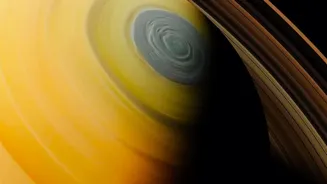
The James Webb Space Telescope has provided a fresh perspective on the planet and its rings, observing them in infrared light. In these images, Saturn's methane-rich atmosphere appears dark because the gas absorbs sunlight, while the icy rings glow brilliantly. This unique view has revealed unexpected features in Saturn's atmosphere, including large-scale aerosol structures in the northern hemisphere and glowing poles that could be related to seasonal effects or auroral activity. Webb's incredible sensitivity is also helping to detect faint moons and intricate structures within the rings, such as mysterious, temporary “spokes” in the B ring, which are thought to be electrically charged dust particles levitating off the main ring plane.
Intricate Textures and Structures
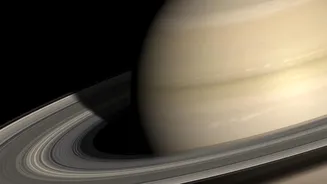
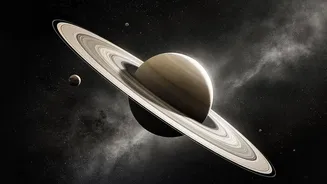
Even after its mission ended, data from Cassini continues to reveal the rings' complex structure. Close-up images show that far from being smooth, the rings have distinct textures described as clumpy, smooth, and streaky. These patterns are sculpted by the gravitational pull of tiny “moonlets” embedded within the rings, which create waves and clear gaps in the material around them. For example, the small moon Daphnis can be seen kicking up vertical waves of material as it orbits within the Keeler Gap. These detailed observations of how masses interact within a disk-like system provide scientists with a valuable window into the processes that form planets and shape entire solar systems.