


A New Class of Worlds
In the vast cosmic ocean, astronomers are discovering planets at a breathtaking rate. Among the most common types are 'super-Earths'—worlds larger than our own but smaller than gas giants like Neptune. They are a missing link in our own solar system,
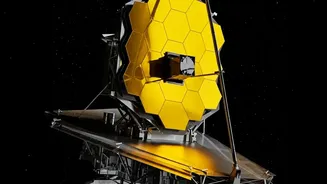
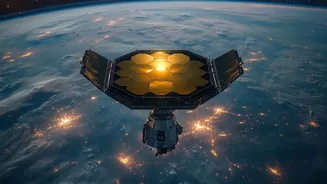
and scientists are eager to understand what they are like. Are they simply scaled-up rocky planets, or something else entirely? The James Webb Space Telescope is uniquely equipped to answer these questions. By looking at these planets, we can gain insight into planetary formation and evolution, helping us understand the conditions that might make a planet habitable. Until the launch of the JWST, detecting the thin veil of an atmosphere around a distant, rocky world was beyond our technological grasp.
Decoding Light from Distant Suns
So, how does JWST 'see' an atmosphere from light-years away? It uses a technique called transit spectroscopy. When an exoplanet passes in front of its parent star from our perspective, a tiny fraction of the starlight filters through the planet’s atmosphere, if one exists. Different gases absorb light at specific wavelengths, leaving a unique chemical 'fingerprint' in the light that reaches the telescope. JWST’s powerful infrared instruments are sensitive enough to capture these minuscule changes in the star's light, allowing scientists to decode the atmospheric composition of these alien worlds. It's a painstaking process, but it's our best tool for determining if these super-Earths have the key ingredients for life.
The Puzzling Case of 55 Cancri e
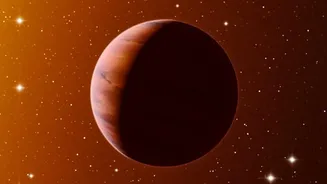
One of the most intriguing targets for JWST has been 55 Cancri e, a scorching hot super-Earth located about 41 light-years away. This planet orbits its star so closely that its surface is likely a molten magma ocean. The telescope’s initial observations yielded a surprise: the planet was cooler than expected if it were just bare rock, hinting at a substantial atmosphere that could be redistributing heat. Further analysis of the data suggests the presence of a secondary atmosphere, one that is constantly being replenished by gases bubbling out of the magma ocean below. Scientists believe this atmosphere could be rich in carbon monoxide or carbon dioxide, marking some of the best evidence to date for an atmosphere around a rocky planet outside our solar system.
A Critical Scientific Caveat
While the discovery of any gas around a rocky planet is exciting, science demands careful verification. The search for water vapour is particularly tricky. Observations of another super-Earth, GJ 486 b, highlighted a major challenge: the water signal might not be from the planet at all. Red dwarf stars, which many rocky planets orbit, are cool enough to have water vapour in their own atmospheres, particularly in cooler regions called starspots. This stellar water can create a signal that perfectly mimics a planetary atmosphere. Recent follow-up studies of GJ 486 b suggest its dayside is likely bare rock, making the star's own activity the stronger explanation for the initial water signal. This crucial context reminds us that every exciting signal must be rigorously tested before we can claim to have found an atmosphere.
A Breakthrough in Capability
Even with these uncertainties, the findings represent a monumental leap forward. For the first time, we are able to detect the incredibly faint signals that might indicate atmospheres on rocky worlds. The ability to even pose the question of whether water vapour is coming from a planet or its star is a testament to the JWST's unprecedented power. These early observations are essentially test runs for the main event: turning the telescope towards cooler, more Earth-like planets. Elsewhere, JWST has definitively found water vapour in the planet-forming disks of dust and gas around young stars, showing that the raw materials for life are available from the very beginning of a planet's formation. Each observation, whether a confirmation or a puzzle, refines our techniques and brings us closer to the ultimate goal.