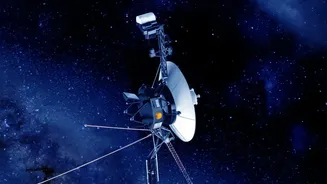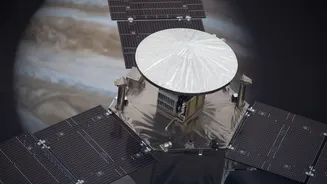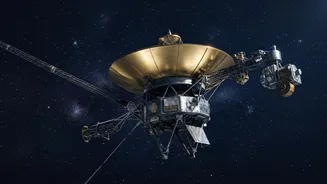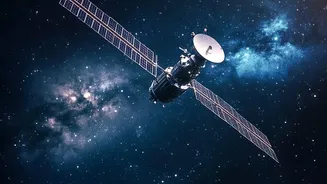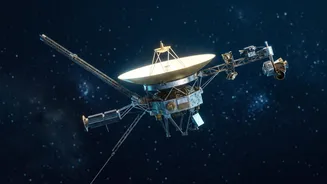



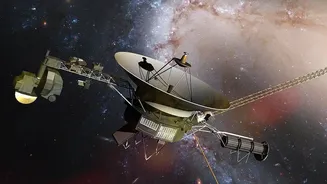
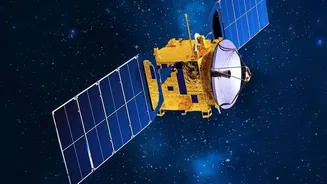
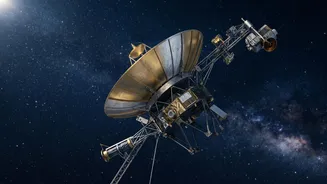
For two tense days, humanity’s farthest emissary, the Voyager 1 spacecraft, was silent. Just weeks before a monumental milestone, its signal vanished, leaving a void across billions of kilometres before it suddenly returned.
A Silence Across The Void
In mid-October, NASA’s Deep
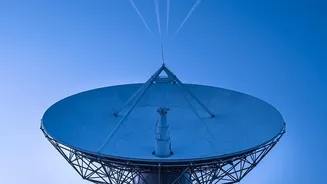
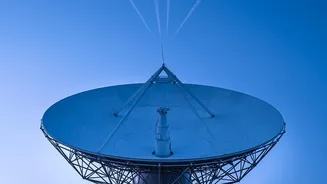
Space Network (DSN), a global array of giant radio antennas, failed to detect a signal from Voyager 1 during two scheduled check-ins, 24 hours apart. For 48 hours, there was nothing. Given that Voyager 1 is nearly 26 billion kilometres away, such a silence is unnerving. Then, on October 20, as mysteriously as it had vanished, the signal returned. To the relief of mission controllers at the Jet Propulsion Laboratory (JPL), communications were back to normal, and the nearly 50-year-old probe had resolved the issue on its own before any commands could even be sent from Earth.
What Caused the Glitch?
Engineers are still investigating the precise cause of the blackout. So far, they have determined that the spacecraft's fault protection system automatically activated. This system detected a problem with one group of thrusters, which are small rockets used for orientation, and automatically switched to a backup set. This response is designed to put the spacecraft into a safe and stable configuration, pausing normal operations to give engineers time to diagnose any issues. While this kind of autonomous action is built into the probe's 1970s-era design, mission managers noted it was the first time they had seen the spacecraft perform this specific maneuver.
The One-Light-Day Milestone
The brief drama occurred just as Voyager 1 is about to achieve a truly mind-bending milestone. On November 18, 2026, it will be exactly one light-day from Earth. A light-day is not a measure of time, but of distance: it is how far light travels in 24 hours, which equates to about 25.9 billion kilometres. No other object made by humans has ever travelled this far. This distance means that communicating with Voyager 1 now involves a 48-hour round trip. A radio signal, travelling at the speed of light, takes a full 24 hours to reach the probe, and any response takes another 24 hours to get back to Earth.
A Mission of Remarkable Endurance
Launched in September 1977, Voyager 1’s original mission was to study Jupiter and Saturn. It completed that task in 1980, but the mission was extended. In 2012, it became the first spacecraft to enter interstellar space, crossing the boundary where the Sun's influence ends. It continues to send back invaluable data about this unexplored region, even with its ancient computer systems, which have less than 70 kilobytes of memory. Its power comes from the decay of plutonium, and with that power source dwindling by about four watts each year, engineers have become experts in energy conservation, recently shutting down some systems to prolong the life of the remaining science instruments.
What's Next for the Intrepid Explorer?
Despite its age and the recent communication scare, Voyager $1$’s journey is far from over. It is currently speeding towards a star named Gliese $445$ at nearly $61$,$000$ kilometres per hour. It will not get there anytime soon, however; it is projected to pass the star in about $40$,$000$ years. For now, NASA engineers hope to keep the mission's remaining science instruments operating into the $2030$s, squeezing every last bit of data from humanity's lonely outpost in the cosmos. The recent glitch serves as a reminder that every day of communication with this pioneering probe is a precious gift, a faint whisper from the edge of our solar system and beyond.