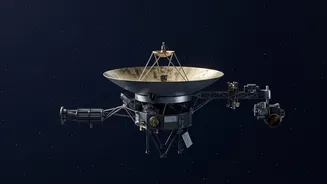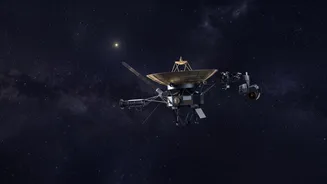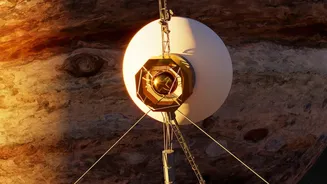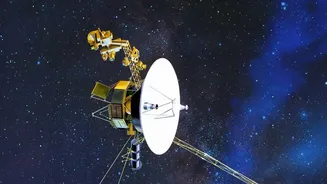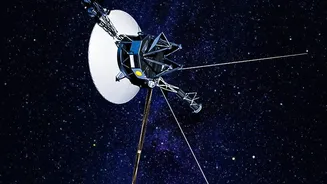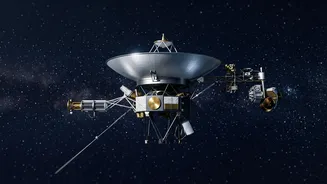


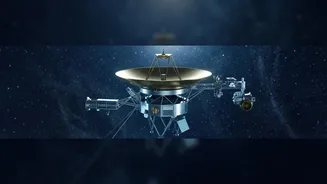
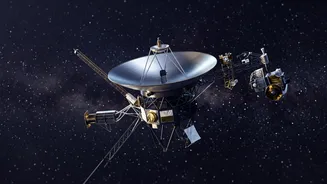
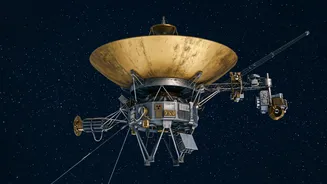
On November 18, 2026, a tiny, tenacious spacecraft will make history. After 49 years of hurtling through the void, NASA’s Voyager 1 will be one light-day away from Earth, a first for any human-made object. But what exactly is a light-day?
An Unprecedented Milestone
At 5:16 a.m.
EST on November 18, Voyager 1 will reach a distance of approximately 25.9 billion kilometres (16.1 billion miles) from our planet. This isn't just a random large number; it represents the distance that light, the fastest thing in the universe, travels in a full 24 hours. From this moment on, any radio signal sent to Voyager 1 will take more than a day to arrive, and any response will take another day to return, making a simple round-trip communication a 48-hour affair. Nothing changes for the steadfast probe itself, which will continue coasting outward as it has for decades, but for us on Earth, it’s a profound reminder of the scale of space.
What is a Light-Day?
Unlike a day, which measures time, a light-day measures distance. Astronomers use light-based units because the distances involved are too vast for kilometres or miles to be practical. A light-day is about 173 times the distance between the Earth and the Sun. To put it in perspective: light from the Moon reaches us in just over a second. Light from the Sun takes about eight minutes. But to cross the gulf to Voyager 1 will now take 24 hours. This immense distance highlights how far humanity's robotic emissary has travelled since it left Earth in 1977.
Light Speed vs. Travel Time
This raises a key question: if light can cover this distance in a day, why did it take Voyager 1 nearly half a century? The answer lies in the colossal difference between Voyager's speed and the speed of light. Light travels at a staggering 300,000 kilometres per second. Voyager 1, while incredibly fast by human standards, moves at about 17 kilometres per second (roughly 61,000 km/h). Though it's one of the fastest objects ever launched, its speed is a tiny fraction of light speed. While sci_fi often imagines ships zipping across the galaxy, the laws of physics and the constraints of propulsion technology mean that even our most ambitious probes travel at a comparative crawl.
A Long and Storied Journey
Launched in 1977, Voyager $1$'s original mission was a 'grand tour' of Jupiter and Saturn. It revealed volcanic activity on Jupiter's moon Io and the complexities of Saturn's rings before its trajectory sent it hurtling out of the plane of our solar system. In $1998$, it became the most distant human-$made$ object. Then, in $2012$, it achieved another historic first by crossing into interstellar space—the region between the stars, beyond the protective bubble of particles and magnetic fields generated by our Sun. Along the way, it turned its camera back one last time in $1990$ to take the iconic 'Pale Blue Dot' photo, showing Earth as a tiny speck in the vastness.
Keeping a nearly $50$-year-$old$ spacecraft running at such a distance is an engineering marvel. Its nuclear power source is dwindling, forcing NASA engineers to make difficult decisions about which instruments to shut down to conserve energy. The probe has also faced recent technical glitches, including a memory error in $2024$ and a brief communications blackout in October $2026$ that resolved itself before controllers could intervene. Despite these challenges, Voyager $1$ continues to send back invaluable data from interstellar space, where no other probe has ventured.