
What Did Webb Actually Find?
In a series of stunning observations, the James Webb Space Telescope has detected significant amounts of water vapour in the atmospheres of several exoplanets, which are planets that orbit stars other than our Sun. While the headline mentions deep-field
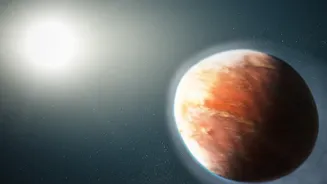
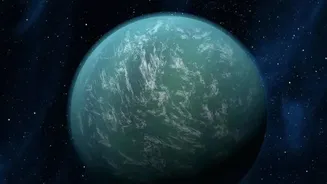
images—which the telescope uses to capture vast panoramas of ancient galaxies—this discovery was made using a different, more focused technique. Scientists pointed the telescope's sensitive instruments at known exoplanets, such as WASP-96 b and TOI-421 b, to analyse their air in detail. In the case of WASP-107b, a nearby exoplanet, JWST not only found water vapour but also sulfur dioxide and even clouds made of silicate sand. These aren't images of oceans or rivers, but rather the chemical signature of water molecules mixed into the atmospheric gases of these distant worlds.
How Scientists Read an Alien Atmosphere
Detecting what a planet's air is made of from light-years away sounds like science fiction, but the method, called transit spectroscopy, is ingeniously simple in concept. As an exoplanet passes in front of its host star from our perspective, a tiny fraction of the starlight filters through the planet's atmosphere. Different gases in that atmosphere absorb specific colours, or wavelengths, of light. The JWST's powerful spectrographs act like cosmic prisms, splitting the starlight into a rainbow-like spectrum. By looking for the specific colours that are missing, astronomers can identify the chemical fingerprints of the molecules that absorbed them. A distinct pattern in this spectrum serves as a definitive signature for water, carbon dioxide, or methane. It's like knowing what's in a smokestack by analysing the colour of the light that passes through its plume.
Why Finding Water Vapour Is a Big Deal
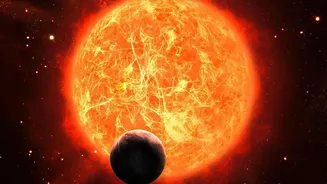
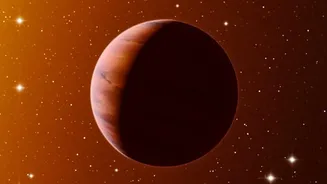
On Earth, water is the essential ingredient for life as we know it. Finding it elsewhere, even as a gas in the atmosphere of a blisteringly hot 'sub-Neptune' or 'hot Jupiter', is a monumental step in the search for habitable worlds. This discovery doesn't mean we've found life. Many of the planets where water has been detected, like WASP-39 b with a temperature of 900 °C, are far too hot to support life. However, it proves that the raw materials for life are present in other solar systems. More importantly, it confirms that the JWST can detect these biosignatures. The ultimate goal is to use this same technique on smaller, rocky, Earth-like planets located in the 'habitable zone'—the orbital range where liquid water could potentially exist on a planet's surface.
The Telescope That Made It Possible
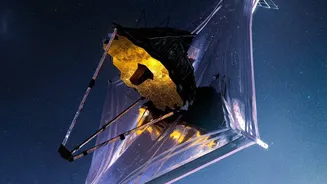
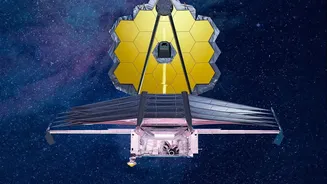
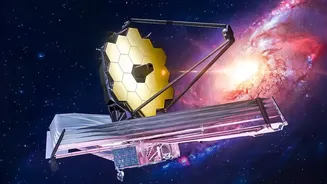
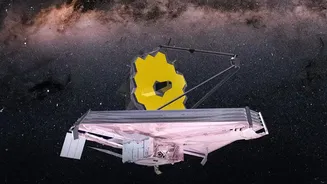
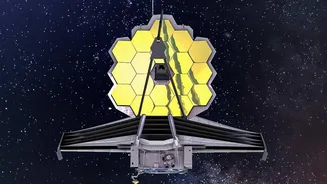
Before the James Webb Space Telescope, efforts to study the atmospheres of smaller planets often produced frustratingly blank results, with clouds or haze likely obscuring the view. The Hubble Space Telescope could only hint at the presence of water. But JWST was specifically designed for this task. Its enormous, gold-coated mirror and advanced instruments are optimized to see the universe in infrared light, which is invisible to the human eye. This allows it to pick up the faint chemical fingerprints of atmospheric gases with unprecedented clarity and resolution. The telescope's stability and precision are so great that it can measure the minuscule dip in light required for these atmospheric studies, opening a new frontier in exoplanet characterisation.
What's Next in the Search for Alien Worlds?
This is just the beginning. Each detection of an atmospheric component provides another piece of the puzzle of how planets form and evolve. For example, some findings have already challenged existing theories about planetary evolution. With proof that their methods work, astronomers will now turn their attention to an ever-growing list of compelling targets. The focus will increasingly shift toward smaller, rocky worlds. Scientists will not just be looking for water, but for a combination of gases—like methane and oxygen—that could indicate biological activity. Each observation is a step toward answering one of humanity's oldest and most profound questions: Are we alone in the universe? With the James Webb Space Telescope, we are better equipped than ever to find out.