










The Strain on Legacy Hubs
India's aviation market is one of the fastest-growing in the world, but its infrastructure has struggled to keep pace. The country's two busiest gateways, Chhatrapati Shivaji Maharaj International Airport (CSMIA) in Mumbai and Indira Gandhi International Airport in Delhi,
have long been operating at or near full capacity. This strain doesn't just mean longer queues and crowded terminals for passengers; it creates significant bottlenecks for air cargo, delaying time-sensitive exports and increasing logistics costs for businesses. For India to realize its economic ambitions, it cannot rely on a system where over 90% of air cargo is funnelled through a handful of strained metro airports. The solution lies in decentralization: building new capacity and empowering regional airports.
Navi Mumbai: The Purpose-Built Decongestant
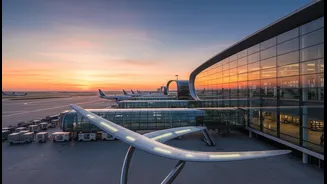
Enter the Navi Mumbai International Airport (NMIA), a game-changer for the Mumbai Metropolitan Region (MMR). Developed as a second major airport for the region, NMIA is designed to directly alleviate the immense pressure on the existing CSMIA. After commencing domestic operations in late 2025, the airport is poised to launch its international services on July 15, 2026. Air India Express is scheduled to operate the inaugural international flight to Abu Dhabi, with IndiGo also expected to commence overseas services. NMIA is not just an overflow facility; it is a mega-hub in its own right, with an ultimate projected capacity to handle 90 million passengers annually. This creates a powerful dual-airport system for the MMR, similar to global cities like London or Tokyo, ensuring the region has the capacity to handle decades of future growth in both passenger and cargo traffic.
Indore's Rise: A Blueprint for Tier-2 Cities
While Navi Mumbai represents a solution born of necessity in a dense metro, Indore’s Devi Ahilyabai Holkar Airport showcases a different, equally vital strategy: empowering Tier-2 cities to become international gateways. For years, passengers and cargo from Central India had to travel to Mumbai or Delhi to fly abroad. Now, Indore is connecting the region directly to the world. It already operates flights to Middle Eastern hubs like Dubai and Sharjah, and a new service to Abu Dhabi is slated to begin on July 15, 2026. This is more than a matter of convenience. Direct international connectivity helps establish cities like Indore as independent economic engines. It allows local industries, including the region's significant pharmaceutical and agricultural sectors, to export their goods faster and more efficiently. Indore’s success serves as a powerful blueprint for how the national UDAN (Ude Desh ka Aam Nagrik) scheme can transform other Tier-2 and Tier-3 cities, fostering balanced regional development.
Beyond Passengers: The Economic Ripple Effect
The true impact of these new international airports extends far beyond passenger travel. They are catalysts for widespread economic activity. For businesses, direct cargo access from regional production centers like Indore is transformative, cutting down on transit times and reducing the risk of damage or delays associated with long road journeys to congested hubs. The massive cargo capacity being built at Navi Mumbai will be crucial for high-value industries like gems, jewellery, and pharmaceuticals. Furthermore, the development of an airport creates an entire ecosystem of jobs in logistics, hospitality, ground services, and retail. These 'aerotropolis' zones become magnets for investment, leading to the development of hotels, commercial parks, and residential projects, fundamentally reshaping urban and regional economies.