








So, What Are Optical Skyrmions?
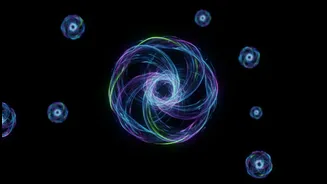
Imagine a tiny, stable whirlpool made not of water, but of light. That's the simplest way to think about an optical skyrmion. More technically, it's a nanometre-sized, particle-like swirl in the properties of a light field, such as its polarisation or electric
field. These patterns are topologically protected, which is a fancy way of saying they are incredibly robust and don't easily unravel or fall apart, much like a well-tied knot. This stability is what makes them so exciting. While similar structures were first studied in magnetic materials, creating them with light opens up a new playground for photonics, the science of using light to transmit information. Scientists see them as potential building blocks for future technologies because they can encode and store information within their swirling patterns.
The 200-Year-Old Physics Trick
The most surprising part of this recent discovery is how it was achieved. Instead of using complex and expensive engineered 'metamaterials,' which was the previous method, scientists from Nanyang Technological University (NTU) in Singapore revived a classic experiment. They shone a laser at a small, opaque circular disc. This creates a phenomenon known as the "Poisson spot" or "Arago spot." In the early 19th century, this effect helped settle a debate about whether light was a particle or a wave. Theory predicted that if light behaved like a wave, it would bend around the disc and create a bright spot right in the center of the shadow — a place you'd expect to be dark. The observation of this spot was a huge win for wave theory. Now, two centuries later, scientists have found that this very spot naturally contains the complex, swirling structures needed to form optical skyrmions.
Why This Discovery Is a Big Deal
This breakthrough significantly lowers the barrier to entry for studying these exotic light particles. By using a simple disc and a laser, researchers can now easily generate, control, and study optical skyrmions, which were previously difficult and costly to produce. The NTU team also found that their method creates four different types of skyrmions at once — related to the light's spin, polarisation, and electromagnetic fields. This allows for unprecedented study of how these different forms interact. The potential applications are immense. Because of their stability and tiny size, skyrmions could lead to ultra-high-density data storage, far beyond what is possible today. They also hold promise for more energy-efficient and faster optical computing and secure quantum communication technologies.
What to Check Before the Hype
While the potential is enormous, it is important to ground our expectations. This discovery is a foundational step, not a market-ready product. The primary achievement is making skyrmions more accessible for research. Several major hurdles remain before you see skyrmion-powered devices. Researchers need to refine their control over creating and manipulating single skyrmions on demand. Ensuring these structures are stable at room temperature and can be integrated into existing semiconductor and photonic circuits are significant engineering challenges. The transition from a lab demonstration to a scalable, reliable, and cost-effective manufacturing process is a long road. While this new method is simpler, it's still a world away from being implemented in the next smartphone or computer. Think of this as the basic science that will fuel innovation for the next decade or more, rather than an immediate update to current technology.