





A New Space Race Fueled by Enterprise
For decades, the exploration of space was a domain exclusive to powerful government agencies. Today, that paradigm has shifted dramatically. A global commercial space race is underway, and India is positioning itself as a key player. Following the Indian
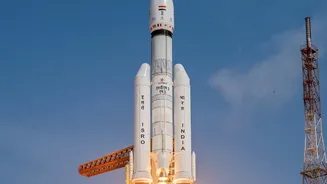
government's landmark decision in 2020 to open the sector to private enterprise, the nation has witnessed an explosion of innovation. The establishment of IN-SPACe (Indian National Space Promotion and Authorisation Centre) as a single-window agency has been pivotal, creating a framework for private companies to thrive. This new policy allows startups to not only build their own technologies but also to access ISRO's world-class infrastructure and expertise, transforming a once-centralised programme into a collaborative national effort. This has paved the way for a vibrant ecosystem of over 400 companies, attracting significant investment and ready to take on the final frontier.
The Pioneers of India's Private Moonshot
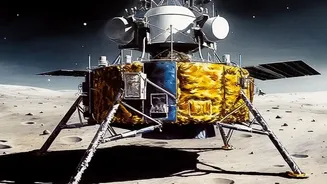
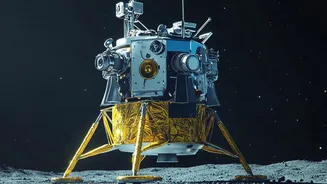
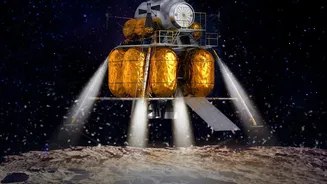
While the Indian startup scene is buzzing with companies focused on satellites and launch vehicles like Skyroot Aerospace and Agnikul Cosmos, a few are setting their sights directly on the Moon. One of the earliest trailblazers was TeamIndus. Though its bid for the Google Lunar XPrize ended without a win, the Bengaluru-based company proved that a private Indian entity could design and develop a lunar lander and rover. The expertise developed by TeamIndus has since carried forward. Its lander design formed the basis for a proposal by OrbitBeyond, a US-based company with a significant Indian engineering arm, which was selected by NASA for its commercial lunar payload services. Today, ORBITBeyond is establishing a major space systems centre in Odisha to design and manufacture lunar landers and rovers, drawing on the experience of engineers from ISRO's Chandrayaan missions. Other startups have also contributed critical technology, such as Noida-based Omnipresent Robot Technologies, which developed the navigation software for ISRO's own Pragyan rover used in the Chandrayaan-3 mission.
Cracking the Code of Low-Cost Exploration
India's reputation for frugal engineering in space, famously demonstrated by ISRO's cost-effective missions, is a core principle for these new startups. Achieving 'low-cost' is not about cutting corners but about smart innovation. Many startups are leveraging in-house design and software development to reduce reliance on expensive imported components. The use of 3D-printed engines, standardized satellite components, and agile development processes allows for rapid prototyping and iteration, drastically cutting down on traditional manufacturing costs and timelines. Furthermore, the government's policy of sharing ISRO facilities for nominal fees eliminates the prohibitive initial investment required for testing and launch infrastructure. Another key strategy is miniaturization; smaller rovers and payloads require less fuel and can be launched on smaller, more affordable rockets, or even hitch a ride as part of a larger mission.
The Mission: More Than Just Footprints
The purpose of these commercial rovers extends far beyond planting a flag. These missions are designed to perform valuable scientific research and technology demonstrations. The objectives include prospecting for resources like water ice, especially in the Moon's uncharted south pole, which could be vital for future long-term human presence. Rovers will also test new hardware, from advanced navigation systems and robotics to radiation-hardened components developed by Indian firms. For the companies building them, these missions serve as a crucial proof of concept, demonstrating their capabilities to potential customers like national space agencies and international science consortia. This creates a commercial market for lunar delivery and exploration services, which is expected to be a multi-billion dollar industry in the coming decades. By pioneering these technologies, Indian startups are not just aiming for the Moon; they are aiming to capture a significant share of the burgeoning cislunar economy.