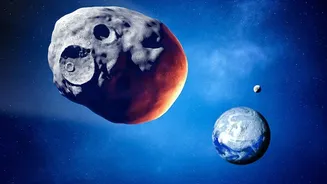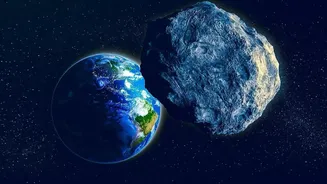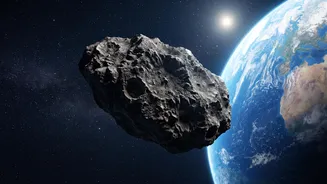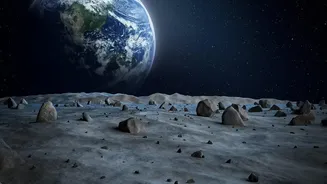



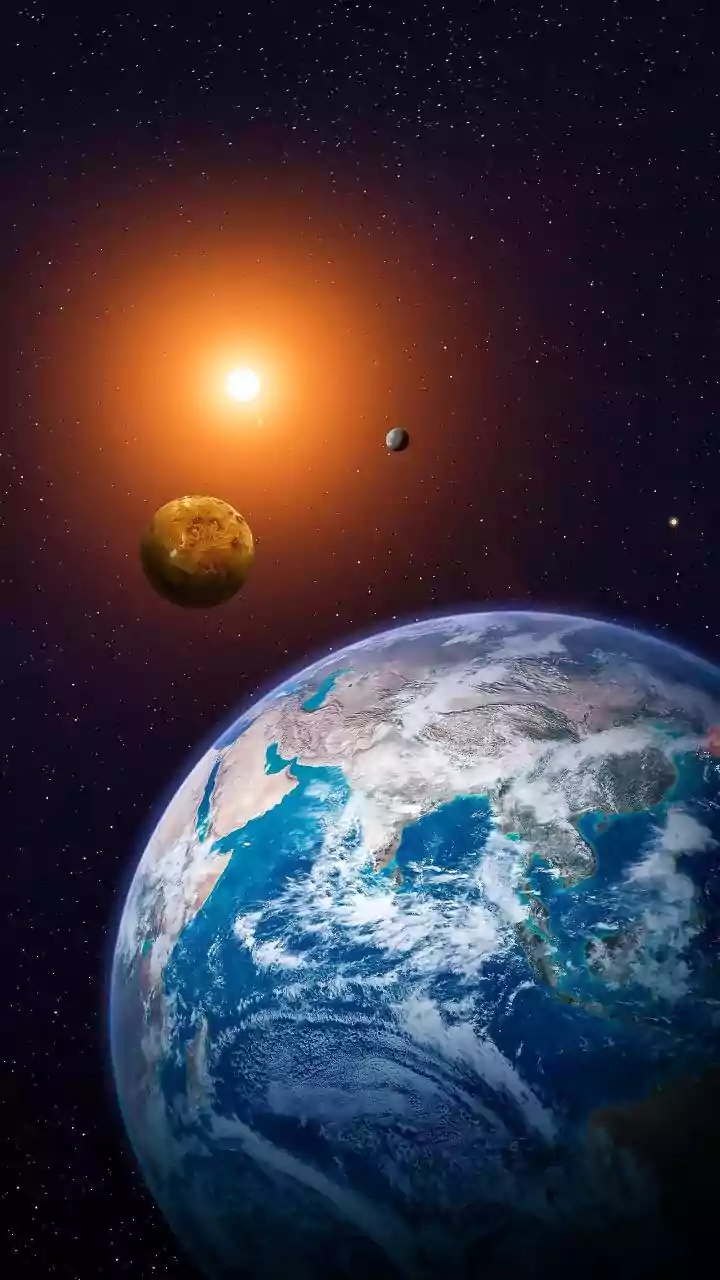
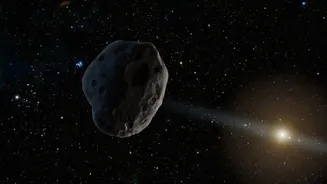

It sounds like science fiction, but Earth has a second, tiny moon, at least for now. An asteroid named 2026 QQ8 was captured by our planet’s gravity in April, and its brief visit is coming to an end as it prepares to drift away in December.
Our Temporary Cosmic Companion
Our solar system
is a busy place, and every so often, a passing space rock gets tangled in Earth’s gravitational pull. This is what happened with 2026 QQ8, a small asteroid only about two metres across. It was first spotted in August 2026 by Hungarian astronomer Krisztián Sárneczky. After weeks of observation to ensure it wasn't a piece of old space junk, astronomers confirmed it was a natural object. Orbital calculations then revealed the surprising truth: the asteroid had been looping around our planet since April, making it a 'temporary satellite' or 'minimoon'. Its journey with us is almost over, as it's expected to break free from Earth's orbit this December or in early 2027 and continue its own path around the sun.
What Exactly Is a Minimoon?
A minimoon isn't a moon in the traditional sense, like our large, permanent companion. Instead, it’s a term for a small asteroid or space rock that gets temporarily captured into orbit around Earth. This happens when an object, already in an orbit around the sun similar to Earth's, passes through a specific region of space called the Hill sphere. Inside this zone, a planet's gravity is the dominant force, overpowering the pull of the sun. If the object enters at just the right speed and angle, it can get caught, beginning a chaotic, wobbly orbit around us. These captures are fleeting; the gravitational influence of the Sun and Moon eventually pulls them away. Most minimoons only stay with us for a few months before being ejected back into a solar orbit.
The Journey of 2026 QQ8
The story of 2026 QQ8 didn't begin in 2026. Astronomers have traced its path backwards and forwards, finding that the asteroid has an orbit that brings it close to Earth roughly every ten years. This year's pass was special, allowing it to be captured for a short while. But don't worry about this visitor getting too close; at its nearest point, 2026 QQ8 will be about 568,000 kilometres away, which is roughly 1.5 times farther than our permanent Moon. Due to its tiny size, you won't be able to see it with binoculars or a backyard telescope. Even if its path were to bring it towards Earth, an object this small would simply burn up harmlessly in the atmosphere, creating a bright meteor.
Not Our First Cosmic Roommate
While the idea of a second moon sounds novel, 2026 QQ8 is not the first of its kind. Scientists believe that Earth likely has at least one minimoon orbiting it at any given time, but they are incredibly difficult to find because of their small size and speed. One of the first confirmed examples was 2006 RH120, which orbited Earth for about a year between 2006 and 2007. Another, 2020 CD3, was a guest in our orbit for about three years. Each discovery helps astronomers refine their models and understand just how common these temporary companions are. Some studies suggest there could be multiple undiscovered fragments orbiting us right now.
Why Scientists Study Minimoons
These fleeting visitors are more than just cosmic curiosities. They are scientifically valuable. Minimoons are essentially free samples of asteroids delivered right to our doorstep. Studying them provides a unique chance to analyse materials from the early solar system without the immense cost and complexity of a mission to the main asteroid belt. They can offer clues about the formation of planets and the composition of asteroids. Because they are relatively close, minimoons are also considered ideal targets for future robotic missions, serving as testbeds for asteroid exploration and even potential resource utilisation, such as mining for water or metals in space.