
A Star's Final Chapters
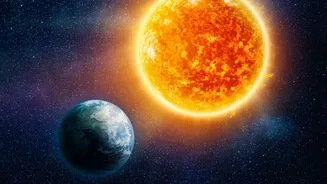
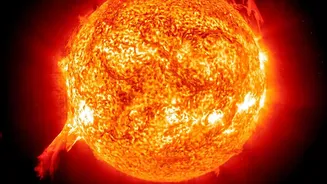
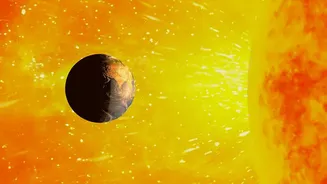
Like all stars, our Sun has a finite lifespan. In about five billion years, it will exhaust the hydrogen fuel in its core and begin a dramatic transformation. The first stage of its demise involves swelling into a red giant. As it expands, its outer layers
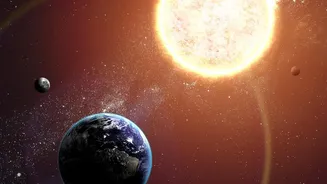
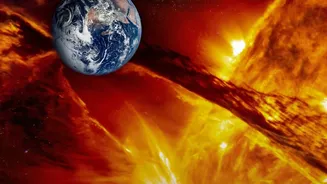
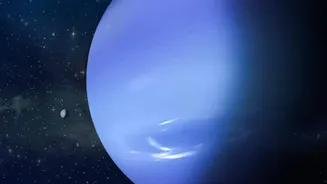
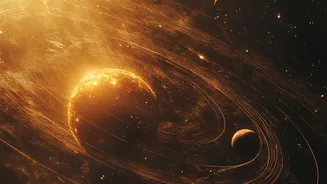
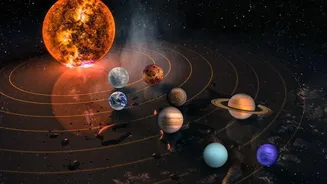
will extend hundreds of times larger than its current size, becoming so vast it will engulf the inner planets. Mercury and Venus are almost certain to be consumed, and while Earth's ultimate fate is debated, our world will be scorched and rendered uninhabitable long before the Sun's surface reaches it. The outer planets—Jupiter, Saturn, Uranus, and Neptune—are too far away to be swallowed, and for a long time, scientists believed they would quietly survive, settling into new, wider orbits.
The Sun's Bumpy Demise
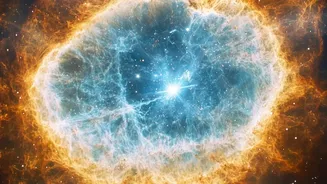
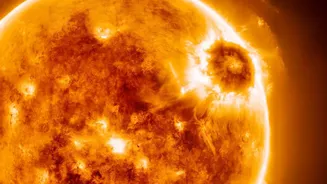
After the red giant phase, the Sun will cast off its outer layers, leaving behind a hot, dense core the size of Earth known as a white dwarf. This stellar remnant will contain about half of the Sun's original mass. For decades, models assumed this mass loss would be a smooth, gradual process, allowing the surviving planets to drift into larger, but stable, orbits. However, a recent study published in The Astrophysical Journal Letters proposes a much more violent end. Researchers from Caltech and the University of Michigan suggest the Sun will shed its mass not in a gentle stream, but in uneven, asymmetric bursts. Each burst would give the dying Sun a small gravitational 'kick', subtly jostling its position. While these kicks are tiny, their cumulative effect over thousands of years is enough to disrupt the delicate gravitational balance of the entire system.
A New Gravitational Dance
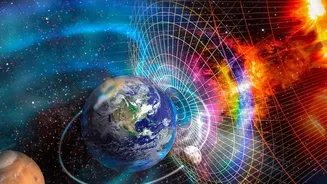
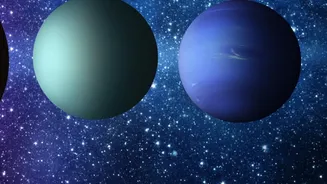
This new model of a 'shaky' dying Sun dramatically changes the long-term forecast for the outer planets. As the Sun's mass decreases, its gravitational grip on the outer planets weakens, causing their orbits to expand. In a smooth mass-loss scenario, this expansion is orderly. But with the added gravitational kicks, chaos is introduced. The new simulations show that the once-orderly orbits of Jupiter, Saturn, Uranus, and Neptune can become unstable, cross each other, and lead to a complete reordering of the outer solar system. Previous estimates suggested the outer system could remain stable for up to a quintillion years. The new research shortens that timeline drastically, to just a few billion years after the Sun becomes a white dwarf.
Jupiter the Wrecking Ball
In this new, less stable environment, Jupiter's immense gravity becomes a major source of disruption. As the orbits shift and expand, the gravitational influence Jupiter exerts on its neighbours becomes more pronounced and unpredictable. The simulations run by the researchers showed a wide range of possible outcomes. In many scenarios, the giant planets are thrown into chaotic, intersecting paths. Some simulations ended with Uranus and Neptune swapping orbits, while others resulted in one or more planets being ejected from the solar system entirely, destined to roam interstellar space as rogue planets. According to the study, in the most realistic scenarios, there's a significant chance of this disruption beginning even before the Sun has fully transitioned into a white dwarf.
The Solar System's Final Act
This research provides a fascinating glimpse into the ultimate fate of our cosmic home. While the inner solar system is doomed to be incinerated, the outer planets face a different kind of end: not one of fire, but of gravitational chaos. The study underscores that a star's death is not a quiet event that its planets will passively survive. Instead, the very act of dying triggers the final unraveling of the system it created. As one of the study's authors, Konstantin Batygin, explained, the Sun's death 'is the trigger for their orbital undoing'. For centuries, even Isaac Newton wondered if the solar system's gravitational clockwork would eventually break down. This study suggests he was right, but for a reason he never could have predicted: the perpetrator of the chaos will be the Sun itself.