




The Soul of the Boat
The journey of a snake boat begins long before its construction, with the careful selection of wood. Artisans traditionally choose the Anjili tree (Artocarpus hirsutus), a type of wild jackfruit wood known for its resistance to rot and its inherent strength.
The main hull planks must be long, straight, and flawless. The selection is a ritual in itself, often beginning on an auspicious day chosen by the master carpenter, or ‘Moothashari’. The belief is that the wood possesses a life force, and its preparation is about honouring that spirit. The wood is seasoned for an extended period to ensure it has the perfect balance of hardness and pliability before a single cut is made.
Keepers of an Ancient Craft
The construction of a Chundan Vallam is not documented in modern blueprints but is passed down orally through generations of master carpenters. These artisans, known as Acharis, guard their families' unique building methods closely. The entire process is guided by the ‘Sthapathya Veda,’ an ancient treatise on construction. The head carpenter directs the team, making intricate calculations based on centuries-old knowledge to ensure the boat's perfect balance and speed. This hereditary wisdom is what transforms planks of wood into a vessel that can carry over 100 rowers in perfect synchrony.
The Test of Tallow and Touch
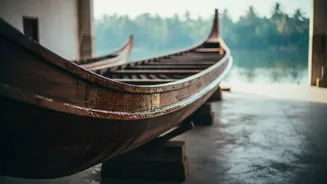
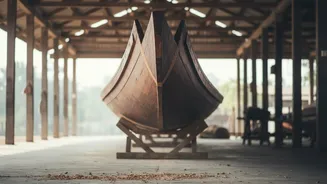
The headline's core question is answered not with a single test, but through an integrated process of treatment and observation. The flexibility isn't measured with gauges; it's felt. Before the racing season, and during construction, the hull is coated with a special concoction. This traditional varnish is a mixture of fish oil, ash from burnt coconut shells, and egg whites. This curious blend does two things: it acts as a waterproof sealant and, more importantly, it seeps into the wood, nourishing it and making it supple. This process makes the long planks flexible without sacrificing strength. While modern boat surveyors might tap a hull with a mallet to listen for the dull thud of rot, these artisans use their hands and eyes. They feel the give of the timber as they bend and join the long planks, listening to the creaks and groans of the wood to understand its limits.
Ritual and Engineering Combined
The process is inseparable from ritual. The start of construction, known as 'Ulikuthal', is a ceremony in itself. Another key ritual is the 'Malarthal karmam', where the entire village helps to flip the massive boat upside down for hull treatment. These are not just symbolic acts; they are critical engineering steps woven into a cultural fabric. Prayers are offered to consecrate the vessel, transforming it from a simple boat into a 'Pallyodam'—a sacred vessel belonging to the deity of the local temple and the pride of the village. Villagers treat the boat with reverence, and traditionally only men, walking barefoot, are allowed to touch it. This deep respect underscores the belief that the boat is a living entity.
Why Flexibility Equals Speed
A snake boat can be over 100 feet long, and its incredible length requires a degree of flex. A perfectly rigid hull would be brittle and prone to cracking under the immense, rhythmic stress of more than a hundred oarsmen pulling at once. The flexibility allows the boat to absorb these forces and move through the water with a unique, undulating motion that gives it its name. This serpent-like movement is what allows the boat to achieve astonishing speeds, covering distances of over a kilometre in just a few minutes. The hull's ability to flex and respond to the crew's power is the secret to its legendary performance in the thrilling Vallamkali races.