



A Planet's Faint Shadow
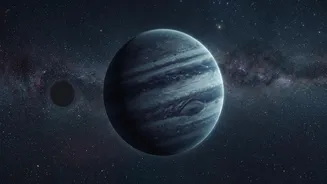
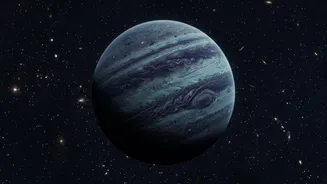
First, let's meet the main character in this celestial mystery: TOI-2535 b. Located in a star system far beyond our own, this planet is what astronomers call a 'warm Jupiter'. It's a gas giant, similar in nature to our own Jupiter, but orbiting much closer
to its parent star. It was initially discovered using the 'transit method', which has been the most successful technique for finding new worlds. This method relies on detecting the faint, regular dip in a star's light that occurs when a planet passes in front of it from our point of view, casting a shadow a bit like a moth flying in front of a distant streetlamp. NASA's Transiting Exoplanet Survey Satellite (TESS) is a master at this, scanning the skies for these telltale winks from distant stars.
The Case of the Missing Transit
The discovery of TOI-2535 b was exciting, but the real puzzle began during follow-up observations. When astronomers pointed their telescopes back at the star, expecting to see the planet make its scheduled pass, there was nothing. The dip in starlight was gone. This was perplexing. Planets do not simply vanish. Had the initial detection been a mistake? Was it an equipment malfunction? Or was something far more interesting happening? The absence of a transit meant the planet was no longer crossing the face of its star from our perspective on Earth, a scenario that sent research teams scrambling for an explanation for this game of cosmic hide-and-seek.
The Great Cosmic Wobble
The latest research provides a compelling and elegant answer: the planet's orbit is wobbling. The technical term for this phenomenon is orbital precession. Think of a spinning top. As it spins, its axis doesn't stay perfectly upright; it slowly traces a small circle. A planet's orbit can do something similar. The entire orbital plane, the flat 'disc' on which the planet travels around its star, can tilt and rotate over long periods. In the case of TOI-2535 b, its orbit has tilted just enough that its path, as seen from Earth, now misses its star's disc entirely. It still orbits its star faithfully, but it no longer passes directly in front of it. The planet isn't gone; its shadow is simply falling elsewhere.
A Hidden Companion's Nudge
So what could cause an entire planet's orbit to wobble so dramatically? The most likely culprit is gravity. Researchers now strongly suspect there is at least one other massive object in the TOI-2535 system, likely another large planet or perhaps a small star. The constant, subtle gravitational pull from this unseen companion is tugging on TOI-2535 b, causing its orbital plane to precess. This is a classic case of celestial mechanics at work. The wobble is not a random event but a predictable, if slow, dance dictated by the gravitational influence of its neighbours. The disappearing act of TOI-2535 b is, in fact, a giant clue pointing to the existence of another, yet-to-be-discovered world in the same system.
Why a Wobbling Planet Matters
This discovery is more than just solving a single puzzle; it has major implications for the entire field of exoplanet science. It shows that planetary systems are not static, clockwork mechanisms. They are dynamic and can evolve in ways that change what we can observe over relatively short timescales. It means that some planets detected via the transit method might seem to 'disappear', while other planets whose orbits are currently misaligned could one day wobble into view and begin transiting their stars. This finding forces astronomers to account for orbital precession when cataloguing alien worlds and highlights that a 'missing' planet might just be hiding, offering clues to even more discoveries just waiting to be made.