









The Commuter's Reading Dilemma
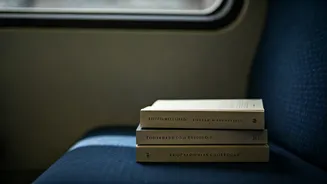
We’ve all been there: you find a precious seat on a crowded bus or train, pull out a 500-page bestseller, and read the same paragraph four times before giving up. The constant interruptions, lack of personal space, and the stop-start nature of travel
make deep, immersive reading nearly impossible. Trying to keep track of a dozen characters and a complex plot over a 30-minute journey often leads to frustration, not relaxation. This experience can make reading feel like a chore, when it should be a refuge. The solution isn't to doom-scroll on your phone, but to radically rethink your travel library. It's time to shift from literary marathons to brilliant sprints.
Embrace the Power of the Novella
Often overlooked, the novella is the commuter’s perfect companion. Typically under 200 pages, a novella offers a complete, satisfying narrative arc without the long-term commitment of a full-length novel. You get rich characterisation and a fully developed plot that you can often finish in just a few sittings. Think of classics like F. Scott Fitzgerald's 'The Great Gatsby' or Vivek Shanbhag's contemporary 'Ghachar Ghochar', a sharp critique of middle-class India. These books are short enough to fit in any bag and can be consumed in their entirety over a week's worth of commutes, giving you a powerful sense of accomplishment. They prove that a story’s impact is not measured by its page count.
Discover Short Story Collections
If your commute is unpredictable, a collection of short stories is your best bet. Each story is a self-contained universe, making it ideal for stop-start reading sessions. You can dive into a complete tale between two metro stations and not worry about losing the thread. For an Indian context, the options are spectacular. R.K. Narayan's 'Malgudi Days' offers charming tales of a fictional South Indian town, while Jhumpa Lahiri’s 'Interpreter of Maladies' explores the Indian-American experience with nuance and heart. Newer collections like Jane Borges’ 'Bombay Balchao' capture the spirit of city life through interconnected vignettes. A good collection allows you to sample different moods, styles, and authors in one volume.
Try Essays and Smart Non-Fiction
Commutes can also be a time for learning and reflection. Non-fiction books structured as a series of essays or distinct chapters are perfect for this. Each chapter can be read as a standalone piece, delivering a concise burst of knowledge or a new perspective. Consider Chimamanda Ngozi Adichie's 'We Should All Be Feminists', a powerful essay that began as a TED Talk, or George Orwell’s 'Why I Write'. These are books you can dip in and out of, pondering a single idea throughout your journey. They provide intellectual stimulation without requiring you to memorise a long, linear argument, making your travel time both productive and thought-provoking.
Revisit Poetry's Compact Punch
Don’t forget poetry. In an age of information overload, the precision and emotional depth of a poem can be a powerful antidote. A single poem can be read in minutes but contemplated for the entire ride. A slim volume of poetry is easy to carry and offers a different kind of engagement—one that values feeling and imagery over plot. Collections by poets like Philip Larkin or the works of Rabindranath Tagore can transform a mundane journey into a moment of beauty and introspection. Reading poetry forces you to slow down, even amidst the chaos, and find meaning in carefully chosen words, offering a profound sense of calm.