






The Four-Wing Advantage
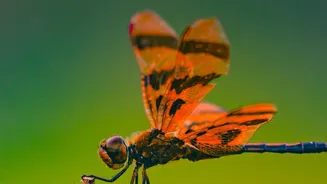
The secret to a dragonfly's incredible agility lies in its two pairs of wings. Unlike many other insects that have two wings or four wings that are coupled to move together, dragonflies can control each of their four wings independently. This gives them
an unparalleled level of control over their flight. They can alter the angle, speed, and timing of each wing's flap to generate a stunning variety of manoeuvres. This independent control allows them to fly forwards, backwards, sideways, and even hover in one spot with remarkable stability.
The Science of the Hover
Hovering is one of the dragonfly's most impressive feats. To remain stationary in mid-air, they beat their forewings and hindwings out of phase with each other. This 'counter-stroking' motion is incredibly efficient. As the forewings create a downwash of air, the hindwings can catch this wake to generate extra lift, reducing the overall energy needed to stay airborne by up to 22%. By precisely adjusting the angle and rotation of each wing during the upstroke and downstroke, the dragonfly creates a constant upward force that perfectly balances gravity, allowing it to hang motionless in the air.
Direct Muscles for Rapid Response
What makes this fine control possible is the dragonfly's unique muscular system. Most insects use indirect flight muscles, which deform the thorax to make the wings beat. Dragonflies, however, have powerful direct flight muscles that attach directly to the base of each wing. This setup is more like rowing a boat, where a small movement at the base produces a large movement at the tip. This direct connection allows for faster and more precise adjustments, enabling the dragonfly to react in milliseconds to chase prey or evade predators. The thorax itself is a muscular powerhouse, internally braced to handle the immense stress of these powerful wing beats.
Complex Wings and Smart Sensors
Dragonfly wings are not simple, flat planes. They are complex structures with veins, corrugations, and a mix of stiff and flexible materials that give them exceptional aerodynamic properties. This intricate design helps prevent the wings from deforming harmfully under stress while allowing for the flexibility needed to generate flight forces. Furthermore, the wings are covered in hundreds of sensory neurons that provide real-time feedback to the insect's brain about airflow and wing position. This allows the dragonfly to make constant, tiny adjustments to maintain stability or execute a sharp turn, a process known as morphological computation.
Nature's Drone: Inspiring Technology
With their superior manoeuvrability and efficiency, dragonflies are the ultimate flying machines. It's no surprise that engineers and roboticists look to them for inspiration. Researchers are developing flapping-wing drones that mimic the dragonfly's shape, independent wing control, and lightweight structure. The goal is to create more agile and energy-efficient micro aerial vehicles (MAVs) that can perform tasks impossible for current rotary drones, such as navigating tight spaces, exploring fragile environments, and carrying awkward loads. From their nearly 360-degree vision to their 95% hunting success rate, dragonflies offer a blueprint for the future of robotic flight.