



The Universe’s Ultimate Speed Limit
The magic behind this cosmic time travel is a fundamental rule of physics: the speed of light. Light travels incredibly fast, at about 300,000 kilometres per second. At this speed, a beam of light could circle the Earth more than seven times in a single
second. It feels instantaneous to us when we flip a switch in a room. But in the vastness of space, distances are so immense that even this incredible speed isn't enough to give us a live view of the cosmos. To measure these distances, astronomers use a unit called a 'light-year'. This isn’t a measure of time, but of distance. A light-year is the distance light travels in one year, which is a staggering 9.46 trillion kilometres. So, when we say a star is 10 light-years away, we mean the light we see from it tonight started its journey a decade ago. We are, quite literally, looking into the past.
Postcards From Across the Centuries
Let’s bring this home. Many of the bright stars you can spot from India are sending us messages from different eras of human history. Take Sravana, also known as Vega, one of the brightest stars in our summer sky. It is about 25 light-years away. The light you see from it tonight left when India was just beginning its journey with economic liberalisation in the early 1990s. Look towards the hunter constellation, Kalpurush (Orion), and you’ll find the brilliant star Agni, or Betelgeuse. It’s a red supergiant about 640 light-years from Earth. The light striking your eye from Betelgeuse began its journey around the time the Mughal Empire was solidifying its rule under Shah Jahan. Every star tells a different story from a different point in time. The night sky isn't a static image; it's a layered collage of ancient history.
Are We Seeing Ghost Stars?
This leads to a mind-bending question: if a star is hundreds or thousands of light-years away, could it have already died? The answer is yes. A star could have exploded in a supernova, collapsed into a black hole, or simply faded away, and we wouldn't know it until its last rays of light completed their long journey to Earth. Betelgeuse is a prime candidate for this. It is nearing the end of its life and is expected to go supernova sometime in the next 100,000 years. It could have exploded 500 years ago, and we would be none the wiser. We would continue to see it shining brightly in our sky until the year 2664 or so, when the light from its spectacular death finally reaches us. For all we know, some of the stars we admire nightly are already cosmic ghosts, their light still travelling through space as a final testament to their existence.
Looking Back to the Dawn of Time
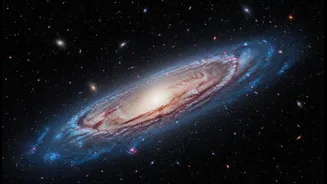
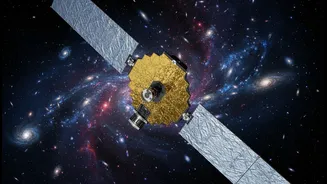
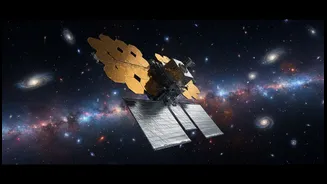
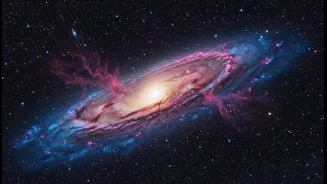
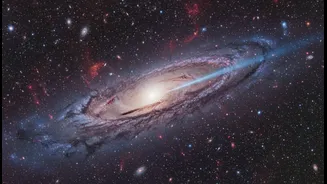
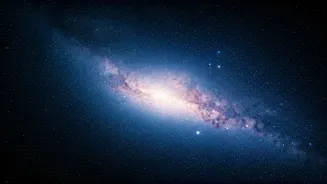
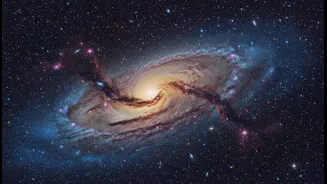
The principle doesn’t just apply to stars. It scales up dramatically. The Andromeda Galaxy is the most distant object that can be seen from Earth with the naked eye. It appears as a faint, fuzzy smudge in the sky. That smudge is a galaxy of a trillion stars, and the light from it has travelled for 2.5 million years to reach us. When that light began its journey, modern humans did not even exist. Our earliest ancestors were just beginning to walk the plains of Africa. Powerful instruments like the Hubble and James Webb Space Telescopes are designed to push this limit even further. They are cosmic time machines, built to capture the faint, ancient light from the very first galaxies that formed shortly after the Big Bang, allowing us to see the universe as it was over 13 billion years ago.