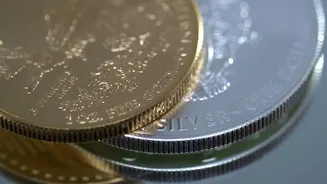








What is the Gold-to-Silver Ratio?
The gold-to-silver ratio is a simple yet powerful metric. It tells you how many ounces of silver it takes to buy one ounce of gold at current market prices. To calculate it, you just divide the price of gold by the price of silver. For example, if gold is trading
at $3,600 per ounce and silver is trading at $40 per ounce, the ratio is 90:1. It’s a straightforward way to compare the relative worth of the two most popular precious metals. As of late November 2026, the ratio stands at approximately 85:1, meaning one ounce of gold could be exchanged for about 85 ounces of silver.
Historical Context is Key
This ratio is not a new invention; it has been tracked for thousands of years, with governments even fixing it for monetary stability in ancient times. In the modern era, the ratio has fluctuated wildly. Over the last half-century, the average has been around 60:1, but it has swung from as low as 17:1 in 1980 to a record high of over 120:1 during the economic uncertainty of 2020. These swings are what make the ratio a point of interest for investors. When the ratio is significantly higher than its historical average, it suggests that silver is undervalued compared to gold. Conversely, a very low ratio suggests gold is relatively cheap compared to silver.
Why Don't They Move Together?
While both are precious metals, gold and silver play different roles in the market, which causes their prices to diverge. Gold is primarily seen as a monetary asset and a safe-haven investment, a hedge against inflation and economic turmoil. Its price often rises during times of fear. Silver, on the other hand, is a hybrid. It is an investment asset but also a crucial industrial metal used in everything from electronics and solar panels to medical devices. This industrial demand makes silver's price more sensitive to the cycles of the global economy. In a booming economy, industrial demand can push silver prices up faster than gold, causing the ratio to fall. In a downturn, the opposite often happens.
How Investors Use the Ratio
Investors use the gold-to-silver ratio as a signal for potential trading strategies, often based on the principle of 'mean reversion'—the idea that the ratio will eventually return to its historical average. A common strategy involves buying silver when the ratio is historically high (e.g., above 80:1), with the expectation that silver will outperform gold in the future, causing the ratio to fall. Some may even sell their gold to buy silver at these times. Conversely, when the ratio is historically low (e.g., below 50:1), they might consider buying gold, anticipating it will outperform silver and push the ratio back up. The goal for some is not necessarily immediate profit in rupees or dollars, but to accumulate more metal over time.
A Tool, Not a Crystal Ball
It is crucial for investors to remember that the gold-to-silver ratio is an indicator, not a guaranteed predictor of future performance. There is no 'correct' ratio, and it can remain at extreme levels for long periods. Factors like central bank policies, inflation expectations, US dollar strength, and changes in mining supply can all influence the prices of both metals independently. The ratio doesn’t cause prices to move; it merely reflects the outcome of two separate markets. Therefore, it should be used as one component of a broader investment analysis, combined with an understanding of market fundamentals and your own financial goals.