

Gathering Light From the Past
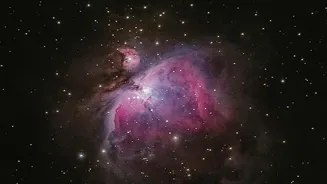
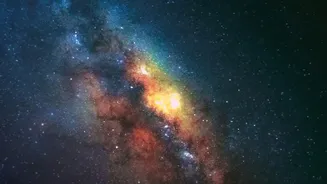
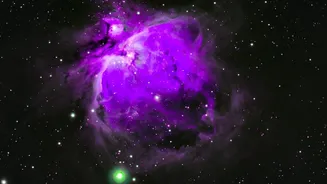
The first step is understanding what's being captured: ancient starlight. The light from a nebula or galaxy may have travelled for thousands, or even millions, of years to reach us. By the time it arrives, it's incredibly faint. An astrophotographer's
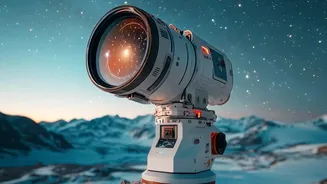
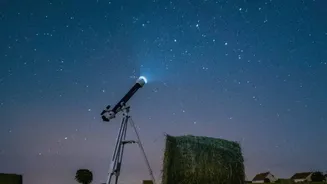
primary job is to collect as many of these precious photons as possible. The telescope isn't just for magnification; its main role is to act as a massive light bucket. The larger the telescope's aperture (the diameter of its main lens or mirror), the more light it can gather, and the fainter the objects it can reveal. This is why you'll often hear astronomers talk about aperture size—it's the key to seeing deep into the cosmos.
The Unsung Hero: The Mount
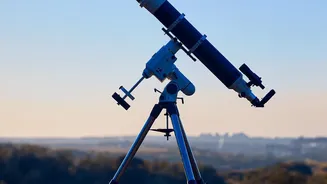
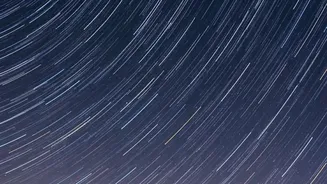
You can have the best telescope and camera in the world, but without a solid, precise mount, your images will be blurry trails. As Earth rotates, the stars appear to move across the sky. To take long exposures—sometimes lasting several minutes each—the mount must counteract this motion perfectly. Most serious astrophotographers use a German equatorial mount. This type of mount is specifically designed to be aligned with the Earth's axis of rotation. Once polar aligned, it only needs to move on a single axis at a constant speed to keep a celestial object perfectly locked in the frame. It is, without a doubt, the most critical piece of equipment for sharp, deep-sky images.
The Modern Digital Eye
This is where modern technology has revolutionized the hobby. In the past, astronomers used specially treated photographic film, a difficult and inefficient process. Today, they use highly sensitive digital sensors, primarily of two types: CCD (charge-coupled device) and CMOS (complementary metal-oxide-semiconductor). While DSLRs and mirrorless cameras can be used, dedicated astronomy cameras offer a huge advantage because they are often cooled. Long exposures generate heat in the sensor, which creates unwanted digital 'noise' that can ruin an image. Cooled astro cameras have built-in systems to keep the sensor's temperature low, allowing for cleaner, longer exposures. While CCDs were once the standard, modern CMOS sensors now offer extremely low noise and high sensitivity, making them popular with amateurs and professionals alike.
The Magic of Stacking
An astrophotographer rarely takes just one picture. Instead, they capture dozens or even hundreds of individual images, known as 'sub-exposures'. These might be anywhere from 30 seconds to 10 minutes long each. This collection of images is then fed into specialized software for a process called stacking. Stacking programs align all the images perfectly and then average them together. This process has a powerful effect: it dramatically reduces random noise while enhancing the faint signal from the deep-sky object. A single three-minute exposure might look grainy and unimpressive, but stacking 60 of them together—for a total of three hours of exposure time—can reveal incredible detail and colour.
From Data to Dazzling Image
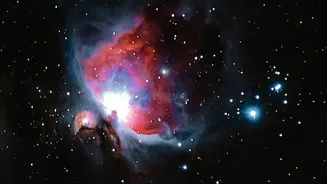
The stacked image that comes out of the software is often dark, colourless, and flat. The final step is post-processing, where the astrophotographer becomes part artist. Using software like PixInsight or Adobe Photoshop, they carefully 'stretch' the data to bring out the faint nebulosity and galactic structure. They adjust colours, enhance contrast, and sharpen details to transform the raw data into the vibrant, detailed masterpiece that we see shared online. This digital darkroom work is as crucial as the data collection itself, requiring both technical skill and an artistic eye to reveal the hidden beauty of the universe captured by the camera.