



A Sweet Find Near the Galactic Center
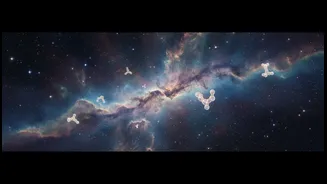
An international team of scientists has identified a molecule called erythrulose, a four-carbon sugar, in the interstellar medium. This isn't the sugar for your morning tea—on Earth, it’s found in raspberries—but its presence in space is a profound discovery.
The detection was made using powerful radio telescopes in Spain, which were pointed at a giant molecular cloud known as G+0.693−0.027, located near the bustling center of our Milky Way galaxy, some 27,000 light-years away. By analyzing the faint radio signals emitted by molecules as they rotate in the near-vacuum of space, researchers matched the specific 'fingerprint' of erythrulose, confirming its existence far from any planet.
More Than Just a Simple Sugar
While simpler sugar-like molecules, such as glycolaldehyde, have been found in space before, the discovery of erythrulose marks a significant step up in complexity. It is considered the first 'true sugar,' or monosaccharide, to be confirmed in the interstellar medium. What surprised scientists was not just its presence, but its abundance. The study revealed that erythrulose is significantly more plentiful than simpler, three-carbon sugars, which were not detected in the same cloud at all. This challenges long-held theories that complex molecules in space form incrementally, by adding one carbon atom at a time. Instead, the researchers suggest that erythrulose may form on the icy surfaces of dust grains from the combination of smaller, two-carbon molecules, a more efficient pathway to complexity.
An Ingredient for the Primordial Soup
This discovery has electrifying implications for astrobiology, the study of the origins and possibility of life in the universe. Sugars are fundamental to life as we know it, forming the structural backbone of RNA and DNA and serving as energy sources for cells. The question of how these vital components first appeared on Earth is a central mystery. One leading theory, known as panspermia, suggests that the raw ingredients for life didn't originate on our planet but were delivered here by comets and asteroids during the solar system's chaotic youth. Finding a complex sugar like erythrulose freely floating in a star-forming region provides strong evidence for this idea. It shows that the chemical precursors to biology are not unique to our world but are manufactured in the vast factories of interstellar space.
The Search for Life's Origins Continues
The detection of erythrulose is not evidence of extraterrestrial life itself, but it powerfully suggests that the conditions necessary for life could be widespread throughout the galaxy. If the building blocks of life are common, it raises the probability that life could emerge on other Earth-like worlds. The discovery has galvanized the scientific community, which is now eager to search for even more complex sugars, particularly the five-carbon sugar ribose, which is a key component of RNA. Detecting ribose would forge an even more direct link between interstellar chemistry and our own biology. Armed with increasingly powerful tools like the James Webb Space Telescope and the ALMA observatory, astronomers are better equipped than ever to continue piecing together the cosmic puzzle of our own existence.