



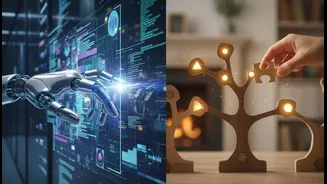



Meet Your New Digital Coworkers
Forget simple chatbots. The new wave of AI in the workplace, represented by platforms like Anthropic’s Claude Cowork and the broader category of “office agents,” function more like autonomous assistants. These tools are designed to handle complex, multi-step
tasks that go far beyond answering a single prompt. They can access and interact with your files, connect to software like Excel and PowerPoint, and execute entire workflows, such as organizing research, drafting reports, or managing projects. Instead of a conversation, you have a working session where you describe an outcome, and the AI plans and performs the steps to get there. This shift from passive tool to active partner is what sets them apart and is beginning to reshape professional roles.
The Challenge for Young Professionals
For young professionals, these AI agents present a dual-edged sword. On one hand, they can act as a career accelerator, automating the routine, entry-level tasks that once consumed the first few years of a career. This allows junior employees to focus on higher-value work like strategy and problem-solving much earlier. However, this automation also poses a significant challenge. Studies have shown a decline in employment for younger workers in AI-exposed fields, as firms begin to substitute AI for the junior labour that historically served as an on-ramp to building skills and experience. The jobs aren't necessarily disappearing, but the traditional entry points are changing, placing greater emphasis on an employee's ability to work alongside AI, using skills like critical thinking and judgment to guide and verify the AI's output.
A Supercharged Toolkit for Analysts
For data, financial, and business analysts, AI agents are transformative. These tools can automate and simplify nearly every stage of the data analysis journey. They can ingest and clean massive datasets from multiple sources, run models to identify patterns and trends, and even generate preliminary summaries and visualizations. This dramatically speeds up the analytics lifecycle, freeing analysts from repetitive, time-consuming tasks. The role is shifting from manual data processing to higher-level interpretation and strategic guidance. Experienced analysts find that while AI can write the basic code or build a report skeleton, human judgment is essential to test, validate, and understand the business context behind the results. The AI handles the 'what,' allowing the analyst to focus on the 'so what.'
Empowering Non-Technical Teams
Perhaps the most significant impact of office agents is the empowerment of non-technical teams. Professionals in HR, marketing, sales, and administration can now perform tasks that once required specialized technical skills. For example, a marketing manager can use an AI agent to analyze campaign data and draft performance reports without writing a single line of code. An HR team can pre-screen resumes or help onboard new hires with AI-guided assistance. These tools act as a great equalizer, democratizing access to powerful analytical and automation capabilities. By handling tasks like scheduling, follow-ups, and internal reporting, AI agents allow these teams to offload administrative burdens and concentrate on strategic initiatives and human-centric work.
The Future is Human-AI Collaboration
The rise of AI coworkers is not about replacing people outright, but about augmenting them. The most effective professionals will be those who learn to collaborate with these digital assistants. This requires a shift in mindset: viewing AI not as a tool to be commanded, but as a teammate that needs guidance, feedback, and critical oversight. Over-reliance on AI without proper verification is a significant risk, as these systems can still make mistakes or lack crucial context. As AI handles more routine and repetitive tasks, uniquely human skills like creativity, strategic thinking, emotional intelligence, and complex problem-solving become more valuable than ever. The jobs of the future will not be about competing with AI, but about leveraging it to achieve goals more effectively.