



Peering Through the Cosmic Dust
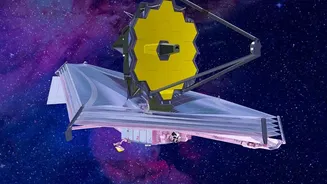
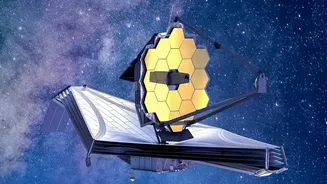
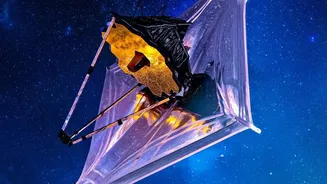
For centuries, astronomers were limited in their study of star birth. Why? Dust. The dense, cool clouds that serve as stellar nurseries are opaque to visible light telescopes like Hubble, shrouding the earliest stages of star formation in mystery. The James
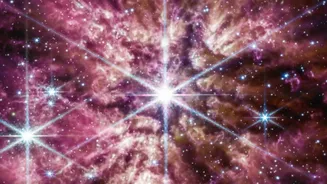
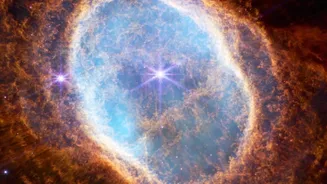
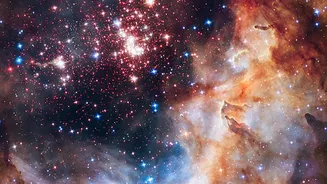
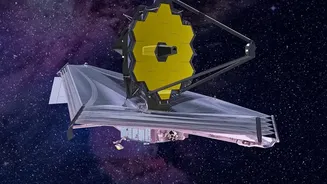
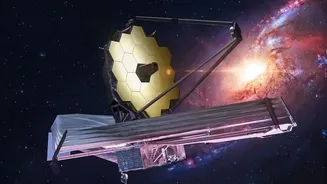
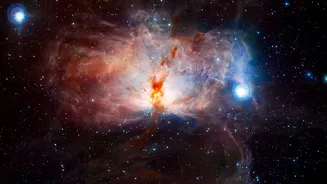
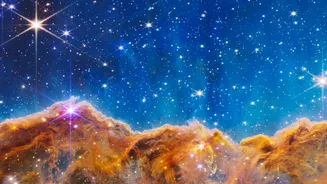
Webb Space Telescope (JWST) was designed to overcome this specific problem. By observing the universe in infrared light, Webb can peer through these dusty veils as if they were nearly transparent. Iconic images like the “Cosmic Cliffs” in the Carina Nebula showcase this power, revealing hundreds of previously hidden, nascent stars that were completely invisible before. This ability to see inside the cocoon is not just about getting a clearer picture; it is fundamentally changing our understanding by allowing scientists to witness the very first, most elusive steps of stellar evolution.
Mapping the Youngest Stars
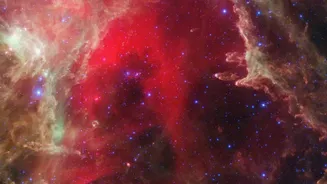
One of the most immediate impacts of JWST's observations is the ability to create a more complete census of newborn stars. With its unparalleled sensitivity, the telescope can detect extremely young and low-mass stars that were previously too faint to observe. In regions like the Serpens Nebula and the active stellar nursery Sagittarius B2, astronomers are now spotting baby stars in their earliest phases, providing a clearer picture of how many stars form in a given cloud and how they are distributed. This has led to surprising discoveries; some studies suggest that the earliest massive galaxies in the universe may have contained far more small stars than models predicted, potentially making them several times more massive than previously thought. This challenges long-held assumptions about how the first galaxies grew so large, so quickly after the Big Bang.
Unveiling Violent Birth Pangs
Star birth is not a gentle process. As a young protostar gathers mass from its surrounding disk of gas and dust, it also violently ejects material in powerful, high-speed jets. Webb's infrared cameras have captured these outflows, known as Herbig-Haro objects, in breathtaking detail. The images reveal intricate shockwaves that are created as the jets slam into the surrounding interstellar gas at supersonic speeds. In a groundbreaking observation in the Serpens Nebula, Webb revealed a series of these jets all aligned in the same direction. Astronomers believe this is direct evidence that the stars formed together from the same spinning cloud, providing a “historical record of the fundamental way that stars are born.” By tracking the movement of these jets, scientists can even read the “fossil record” of a protostar's recent growth spurts.
The Chemistry of Future Worlds
Beyond just taking pictures, Webb is a powerful analytical tool. Its spectrographs can break down the faint light from these stellar nurseries to determine their chemical composition. This allows astronomers to identify the molecules present in the gas and ice, including water, carbon monoxide, and complex hydrocarbons. These are the very building blocks of both stars and the planets that will eventually form around them. Recent studies have focused on how protoplanetary disks—the swirling platters of material where planets form—lose their gas over time. Webb’s observations show that powerful, magnetically driven winds dominate in the early stages, which has huge implications for when and how quickly giant planets like Jupiter must form before their raw material is blown away. This research directly connects the evolution of a star to the potential for life-bearing planets in its system.
Rewriting the Rules of Star Formation
Every new dataset from JWST gives astronomers a chance to test and refine their theories. The telescope's findings are already prompting revisions to long-standing models of stellar evolution. For example, observations have revealed unexpected ultraviolet radiation in the immediate vicinity of protostars, the origin of which is still a puzzle for scientists. Discoveries about the sheer number of low-mass stars are forcing a rethink of how galaxies are weighed. Meanwhile, detailed views of how disks dissipate are changing the timeline for planet formation. Webb is not just confirming what we thought we knew; it is uncovering new complexities and phenomena. It is providing a far more dynamic and chaotic picture of star birth, showing that the process is influenced by everything from magnetic fields to the violent feedback from neighboring massive stars.