



A Universe in a Hurry
For decades, astronomers worked with a relatively tidy model of the universe's childhood. After the Big Bang 13.8 billion years ago, things started slowly. Gravity gradually pulled together massive clouds of gas, which ignited the first stars and, over
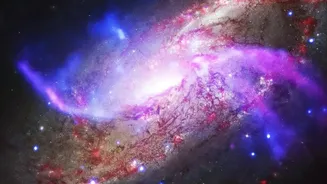
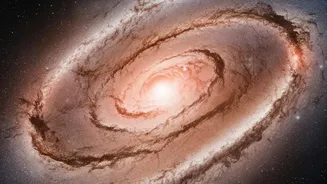
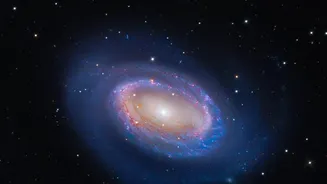
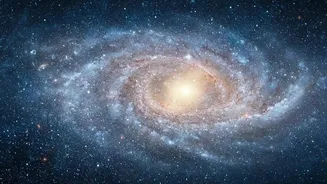
billions of years, these small 'baby' galaxies merged and grew into the grand structures we see today. But recent observations from the James Webb Space Telescope (JWST) are showing this story might be wrong. The telescope has spotted galaxies from when the universe was just a few hundred million years old that are bafflingly massive and mature. These aren't the small, messy 'toddler' galaxies scientists expected; they appear far more developed, some with as much mass as our own Milky Way. This suggests the universe was in a great hurry to grow up, forming large, structured galaxies much faster than our theories predicted.
The Galactic Puzzle Deepens
This flood of new data has created an exciting puzzle for cosmologists. The key issue is time. According to established models, building a billion-star galaxy is a slow process of accretion and merging. Finding such large systems so early in cosmic history is like finding a fully grown adult in a nursery. One major survey, the JWST Advanced Deep Extragalactic Survey (JADES), has been instrumental in these discoveries. It has found objects like JADES-GS-z14-0, a surprisingly bright galaxy seen when the universe was less than 300 million years old. These discoveries don't necessarily break our entire understanding of the universe, but they do point to major gaps in our knowledge. Scientists are now grappling with several possibilities: Was star formation in the early universe far more efficient than we thought? Or could supermassive black holes at the centres of these galaxies be making them appear brighter and more massive than they truly are by furiously consuming gas and emitting vast amounts of light?
Webb’s Time-Travelling Eyes
The reason we can see these ancient galaxies at all is thanks to the unique capabilities of the James Webb Space Telescope. As the universe expands, the light from distant objects gets stretched out, shifting it towards longer, redder wavelengths—a phenomenon known as 'redshift'. For the most ancient galaxies, their light has been stretched all the way into the infrared spectrum. The JWST was specifically designed to be incredibly sensitive to this infrared light, allowing it to see what was previously invisible to telescopes like Hubble. It acts as a powerful time machine. The light from a galaxy seen 13 billion light-years away has travelled for 13 billion years to reach Webb's mirrors, giving us a snapshot of what that galaxy looked like in the distant past. By capturing this faint, ancient light, Webb allows astronomers to directly observe the era when the very first stars and galaxies were being born.
Rewriting the First Chapter of the Cosmos
These findings are forcing a major rethink of the first chapter of cosmic history. The current Standard Model of cosmology provides the overarching framework for the universe's evolution, but these 'impossibly early' galaxies suggest the details need significant revision. Computer simulations that model galaxy formation will need to be adjusted to account for this rapid early growth. It may be that the processes that kick-started galaxy formation were more explosive and rapid than the slow-and-steady models assumed. Some theories suggest that the initial bursts of star formation were incredibly intense, or that the seeds of supermassive black holes formed directly from massive gas clouds in the early universe, providing a gravitational anchor for rapid galaxy growth. While scientists are still working to understand the full picture, one thing is clear: the early universe was a far more dynamic and productive place than we ever imagined.