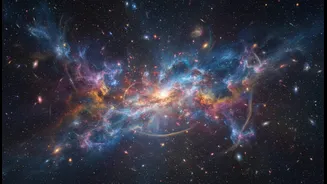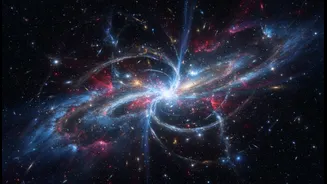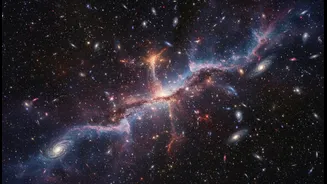




A Cosmic Construction Site
First, let's properly introduce our subject. MACS J0553.4-3342 isn't a star or a single galaxy; it's a galaxy cluster. Think of it less as a finished object and more as a colossal cosmic construction project. Located in the constellation Columba, the light
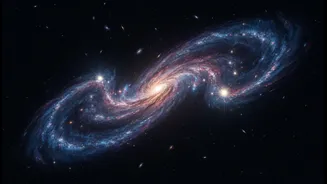
from this cluster has travelled for 4.4 billion years to reach us. Incredibly, this makes it relatively young for such a structure. What the James Webb Space Telescope (JWST) and Hubble have shown us is a cluster in the process of being built. It's composed of two smaller sub-clusters, each anchored by a super-bright, massive galaxy, that are in the middle of a chaotic merger. They have already smashed through each other once and are now over a million light-years apart, but gravity will inevitably pull them back together until they finally combine into one enormous entity. This messy, energetic process fills the space with intensely hot gas that glows in X-rays.
The Ultimate Magnifying Glass
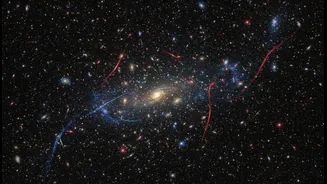
This is where the story gets even more interesting. The immense mass of MACS J0553.4-3342—all those galaxies, the hot gas, and the unseen dark matter—creates something truly special: a gravitational lens. As Albert Einstein predicted, massive objects warp the very fabric of spacetime around them. When light from an even more distant object passes through this warped space, its path is bent, much like light passing through a glass lens. This effect magnifies and brightens objects that would otherwise be too faint and far away to see. In a recent stunning image from the JWST, you can clearly see this in action. The prominent, stretched orange arcs of light are not part of the cluster itself; they are the distorted images of background galaxies whose light has been warped by the cluster's gravity. One such arc is actually three separate images of a single galaxy, its light bent into a cosmic triplet by the lens.
A Window to the Early Universe
This lensing ability is not just a cool cosmic trick; it is one of the most powerful tools in modern astronomy. It transforms these massive clusters into natural telescopes, allowing scientists to peer deeper into the past than ever before. By studying the lensed arcs behind MACS J0553.4-3342, astronomers can see galaxies as they existed less than a billion years after the Big Bang. The JWST's incredible sensitivity allows it to pick up on these magnified details, helping scientists understand how the first galaxies formed and evolved. The VENUS survey program, which captured the new images, specifically targets clusters like this one to hunt for these magnified objects. The goal is to find everything from the earliest galaxies and supermassive black holes to individual supernovae that exploded in the dawn of time.
The Case for a Catchier Name
Which brings us back to the name: MACS J0553.4-3342. It’s a designation from the Massive Cluster Survey, a perfectly functional, if uninspired, catalogue name. But for an object this magnificent—a celestial workshop that bends spacetime and reveals the universe's secrets—it feels inadequate. Science communication thrives on connection, and it’s hard to connect with a string of letters and numbers. We have memorable names for celestial wonders like the Pillars of Creation or the Hubble Deep Field. Even individual lensed stars get evocative nicknames like 'Earendel'. This cosmic construction site, this gravitational titan, deserves a name that reflects its power and importance. Something that captures the image of two clusters locked in a gravitational dance, forging a new cosmic superpower. Perhaps the 'Columba Clash' or the 'Twin Giants'. Anything would be better than a name that sounds like a Wi-Fi password. A great name doesn't just make it easier to remember; it sparks curiosity and invites everyone to share in the wonder of discovery.