



An Invisible Threat from the Sun
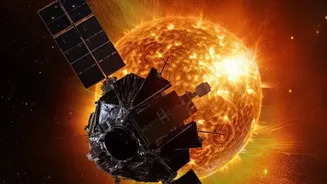
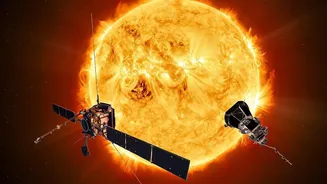
When we think of weather, we imagine rain, wind, or snow. But there's another kind of weather that originates from the sun itself. Space weather refers to the changing conditions in space, driven by solar activity. The primary culprits are solar flares,
which are intense bursts of radiation, and coronal mass ejections (CMEs), which are massive explosions of plasma and magnetic fields from the sun's outer atmosphere. When these phenomena are directed at Earth, they can have profound effects on our planet's magnetic field and upper atmosphere, creating what are known as geomagnetic storms. While these storms are responsible for the beautiful auroras, they also pose a serious risk to the technological backbone of modern society.
Our Fragile Digital Lifeline
Modern life is critically dependent on a vast, interconnected network of technology, much of which is vulnerable to space weather. Global Navigation Satellite Systems (GNSS), including GPS, are particularly susceptible. The radio signals from these satellites must pass through the Earth's ionosphere, a layer of the atmosphere filled with charged particles. During a geomagnetic storm, this layer becomes disturbed, which can delay or distort the satellite signals. This can lead to positioning errors of several meters or even a complete loss of signal lock. The consequences extend far beyond your car's navigation; aviation, shipping, precision agriculture, and even financial systems that rely on precise timing from GPS can all be disrupted. Furthermore, these storms can induce powerful currents in ground-based infrastructure, potentially damaging transformers and causing widespread power outages.
The High Ground of National Security
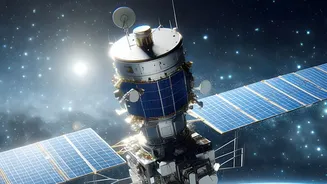
For defense and national security, the stakes are even higher. Military forces are heavily reliant on satellites for communication, intelligence gathering, surveillance, and reconnaissance. GPS is essential for navigating ships and aircraft, as well as for guiding precision munitions. A significant space weather event could temporarily blind these critical systems, creating a major vulnerability. Communications can be blacked out as solar flares disrupt high-frequency radio signals used by the military and air traffic control. Beyond signal disruption, the energetic particles from a solar storm can physically damage satellite electronics and degrade their solar panels, shortening their operational lifespan. Geomagnetic storms can also heat and expand the upper atmosphere, increasing the drag on low-Earth orbit satellites and causing them to drift off course, risking collisions.
The Eyes on the Sky
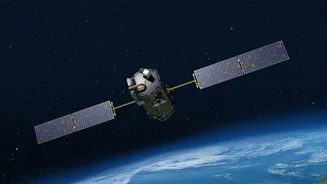
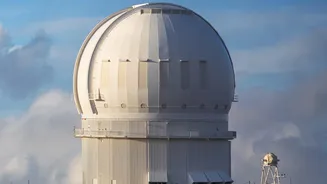
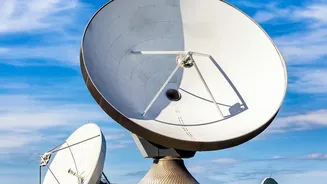
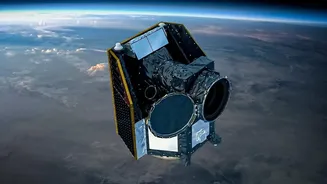
This is where space weather tracking stations become indispensable. They are our first line of defense, acting as an early warning system. These facilities, both on the ground and in space, continuously monitor the sun's activity. Ground-based observatories use instruments like radio telescopes and magnetometers to detect solar flares and track changes in the Earth's magnetic field. Space-based satellites, like the DSCOVR observatory positioned between the Earth and sun, can directly measure the solar wind and provide a crucial, albeit brief, warning before a geomagnetic storm hits. This advanced notice, even if only an hour, gives satellite operators time to put their spacecraft into a safe mode, allows power grid managers to take protective measures, and helps the military prepare for potential communication outages.
India's Growing Stake and Capabilities
As a major space-faring nation with its own critical satellite infrastructure, including the NavIC navigation system, India has a significant interest in space weather. The Indian Space Research Organisation (ISRO) and other institutions like the Aryabhatta Research Institute of Observational Sciences (ARIES) are actively involved in space weather research and monitoring. Collaborations between these bodies aim to enhance India's Space Situational Awareness (SSA), which includes tracking space weather and its effects to safeguard the country's valuable assets in orbit. By establishing more ground-based optical telescopes and developing better predictive models, India is strengthening its ability to anticipate and mitigate the impacts of solar storms, aligning its scientific research with national security objectives.