





An 18-Month Journey to Impact
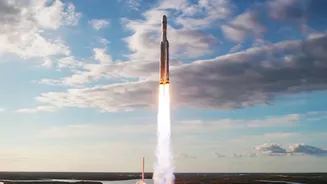
This isn’t a planned mission, but the final chapter of one that began in January 2025. A Falcon 9 rocket successfully launched two commercial lunar payloads: Firefly Aerospace's Blue Ghost lander and ispace's Hakuto-R lander. After deploying its cargo,
the rocket's second stage, a 4-tonne, 45-foot-long piece of hardware, was left in deep space. Over the past year and a half, the complex gravitational pulls of the Earth, Moon, and Sun have slowly altered its path, putting it on a collision course. Today, that journey ends with a high-speed impact near the Moon's Einstein Crater at roughly 8,700 km/h.
A Valuable Accidental Experiment
While the crash is unintentional, scientists are treating it as a valuable, free experiment. Usually, the Moon is struck by natural meteoroids of unknown size, speed, and composition. In this case, researchers know the exact mass, trajectory, and material of the impacting object—a hollow aluminum rocket stage. This provides a rare, controlled-in-a-way dataset to study how craters are formed on the lunar surface. Observing the impact allows scientists to refine the models that predict the outcomes of future collisions, both natural and man-made, which is crucial as lunar traffic increases.
What Scientists Hope to Discover
The primary goal is to see what gets kicked up from beneath the surface. The impact is expected to gouge a new crater roughly 60 feet wide and up to 16 feet deep, blasting a plume of lunar dust and rock, known as ejecta, high above the surface. By analyzing this ejecta plume with space-based and ground-based instruments, scientists can get a glimpse of the Moon's subsurface geology without having to land a mission and drill. This could reveal details about the composition of the regolith and potentially search for signs of water ice, a key resource for future lunar bases.
A Global Observation Effort
Although the impact itself will be too quick and faint to see with the naked eye, a global effort is underway to capture the aftermath. NASA will use its Lunar Reconnaissance Orbiter, which is already circling the Moon, to try and image the impact site before and after the collision to study the new crater. The agency's ShadowCam instrument on South Korea's lunar orbiter will also be on the lookout. Meanwhile, professional and amateur astronomers on Earth, particularly in the Americas, will point their telescopes at the Moon's edge, hoping to catch a glimpse of the ejecta plume rising against the blackness of space.
The New Era of Commercial Lunar Science
This event, while accidental, is a direct consequence of a new era in space exploration driven by commercial enterprise. The original 2025 launch was part of NASA's Commercial Lunar Payload Services (CLPS) program, which pays private companies to deliver scientific and technological payloads to the Moon. This model, championed by companies like SpaceX, has dramatically increased the frequency of lunar missions. It also brings new challenges, including the growing issue of space debris. This impact serves as a powerful reminder that as access to the Moon becomes more common, so too will humanity's footprint upon it.