


In our perpetually busy world, true rest can feel like a distant dream. We sleep, but often wake up tired. What if there was a way to consciously access a state of profound relaxation? Enter Yoga Nidra, an ancient practice for modern minds.
What Exactly is 'Yogic Sleep'?
Yoga Nidra,
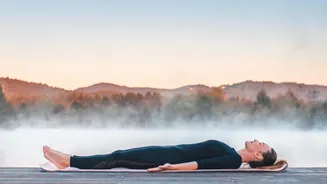
which translates from Sanskrit to 'yogic sleep', is a powerful guided meditation technique that induces a state of consciousness between waking and sleeping. Unlike active forms of meditation that may require you to sit upright and focus, Yoga Nidra is typically practiced lying down comfortably in a pose called Savasana (corpse pose). The goal isn't to simply fall asleep, but to remain aware while the body and mind enter a state of deep relaxation. It's a structured practice that guides your attention inward, allowing you to access a level of rest that often feels more restorative than conventional sleep. The beauty of it is its accessibility; anyone can do it, regardless of their physical condition or prior yoga experience.
Meditation vs. Yoga Nidra: What's the Difference?
While both are powerful tools for mental clarity, meditation and Yoga Nidra have different approaches and goals. Meditation is often an active practice of focusing your attention—on your breath, a mantra, or your thoughts—to cultivate a state of mindful awareness. Yoga Nidra, on the other hand, is more receptive. You are guided through a series of steps and encouraged to let go completely, hovering in the state between wakefulness and slumber. This unique state allows your brain to shift into slower brainwave patterns, like alpha and theta waves, which are associated with deep relaxation, creativity, and the early stages of sleep. Think of meditation as actively training the mind, while Yoga Nidra is about effortlessly allowing the mind and body to rest and restore.
The Journey Inward: A Basic Technique
A typical Yoga Nidra session follows a systematic structure designed to peel back layers of tension. While there are several schools of thought, a common practice involves a few key stages. First, you settle into a comfortable lying position, using blankets or cushions for warmth and support, as body temperature can drop during deep relaxation. The practice begins by bringing awareness to the breath and setting a 'Sankalpa', or intention. The guide then leads you through a 'rotation of consciousness', a body scan where you bring mindful attention to different parts of the body, one by one, without moving them. This is followed by breath awareness exercises and often includes experiencing opposite sensations (like heaviness and lightness) or guided visualizations to deepen the relaxation.
The Power of Intention: Understanding Sankalpa
A core component of many Yoga Nidra practices is the Sankalpa. This is a short, positive statement spoken in the present tense, like 'I am calm and at peace' or 'I am healing'. It's a heartfelt resolve or intention that you silently repeat at the beginning and end of the practice, when the mind is most receptive. Think of it as planting a seed in the fertile ground of your subconscious mind. The idea is that by setting this intention in a state of deep relaxation, you can gently rewire thought patterns and support personal transformation. It becomes a powerful tool for aligning your conscious desires with your subconscious mind.
More Than Just Relaxation: The Science_Backed Benefits
The benefits of Yoga Nidra extend far beyond simple relaxation. The practice helps to activate the parasympathetic nervous system, also known as the 'rest and digest' system. This counteracts the 'fight or flight' response that many of us experience due to chronic stress. Studies have shown that a consistent practice can help reduce stress and anxiety, lower cortisol levels, improve sleep quality, and even help manage chronic pain. By guiding the brain into deeper wave states like theta and delta, which are usually associated with deep sleep and healing, Yoga Nidra allows for profound mental and physical restoration while you are still consciously aware.