


The Challenge of a Hostile World
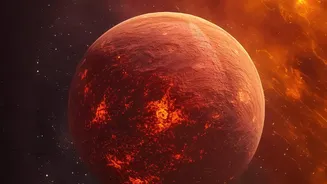
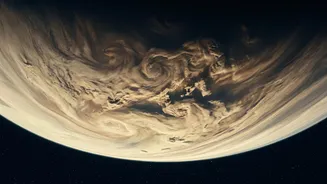
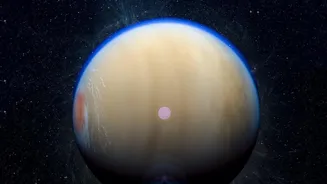
Exploring Venus is incredibly difficult. Its surface is a scorching 460 degrees Celsius, hot enough to melt lead, and the atmospheric pressure is over 90 times that of Earth's at sea level. The planet is permanently shrouded in thick clouds of sulfuric
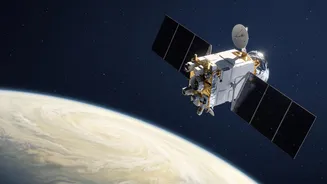
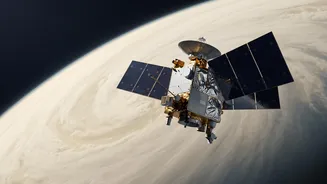
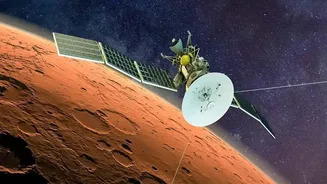
acid, making it impossible to see the surface with conventional cameras. This is why past missions have struggled; the longest any craft has survived on the surface is just over two hours. Shukrayaan, an orbiter mission, is designed to overcome these challenges by studying the planet from a safe distance, using instruments that can peer through the hostile environment. The mission's primary objectives are to investigate Venus's surface and sub-surface, study its atmospheric chemistry, and analyze how the planet interacts with the solar wind.
Piercing the Clouds with Radar
The flagship instrument of the Shukrayaan mission is a high-resolution Synthetic Aperture Radar (SAR). Think of SAR as a way of 'seeing' without light. It sends radio waves down to the planet's surface and listens for the echoes that bounce back. Because these radio waves can penetrate the thick cloud cover, day or night, ISRO will be able to construct a detailed, high-resolution map of Venus's surface. This technology is an improved version of the radar used on the Chandrayaan-2 lunar orbiter and is expected to provide images with up to four times the resolution of NASA's Magellan mission from the 1990s. This will allow scientists to spot geological features, like volcanoes and impact craters, that have never been seen in such detail before, providing crucial clues about the planet's geological evolution.
Exploring What Lies Beneath
Shukrayaan is also slated to be the first mission ever to map Venus's subsurface. It is expected to carry a ground-penetrating radar that will probe several metres below the surface. This is a crucial capability, as it will allow scientists to study the planet's stratigraphy—the layers of rock and soil. By understanding this layering, we can piece together the geological history of Venus, looking for evidence of past volcanic activity, tectonic shifts, or even ancient, buried landscapes. This part of the mission aims to answer fundamental questions about how a planet so similar in size to Earth ended up so different.
Analysing a Toxic Atmosphere
While the radar instruments focus on the ground, a host of other sensors will be aimed at the atmosphere. This includes spectrometers designed to study the composition of the air in infrared, ultraviolet, and submillimeter wavelengths. One key instrument, a collaboration with Russia and France called VIRAL (Venus Infrared Atmospheric Gases Linker), will analyze the atmospheric chemistry. These tools will investigate the planet's runaway greenhouse effect and look for trace gases. Another instrument, the Venus Thermal Camera, will map heat emissions from the clouds to understand their structure and dynamics.
Studying the Solar Wind Connection
Unlike Earth, Venus has no significant magnetic field to protect it from the solar wind—a constant stream of charged particles flowing from the Sun. Understanding how the solar wind interacts directly with the Venusian ionosphere (the charged upper layer of its atmosphere) is a major scientific objective. To do this, Shukrayaan will carry a payload called VISWAS (Venus Ionospheric and Solar Wind particle Analyser), which is being developed in collaboration with Sweden. This instrument package will measure the properties of the plasma environment around Venus, helping scientists understand how the solar wind strips away atmospheric particles, a process that may have contributed to the planet losing any water it once had.