




A Telescope's Unexpected New Talent
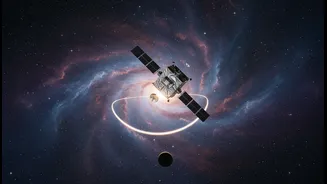
NASA's Transiting Exoplanet Survey Satellite, or TESS, has a very specific job: to stare at hundreds of thousands of stars, looking for tiny, rhythmic dips in their brightness. This 'transit method' is the tell-tale sign of a planet passing in front of its
star, briefly blocking some of its light. It has been incredibly successful, helping scientists find thousands of exoplanets, or worlds outside our solar system. However, this method works best for planets that are large and orbit very close to their stars. The recent discovery of a planet named Gaia23bra b turns this on its head. It was found using a completely different technique, one that TESS was never designed for, proving the satellite is even more capable than its creators imagined.
Bending Space and Time to See
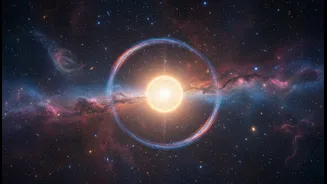
The headline's 'space-time ripples' refers to a fascinating phenomenon predicted by Albert Einstein called gravitational microlensing. According to his theory of General Relativity, massive objects like stars warp the fabric of space-time around them. When a foreground star perfectly aligns with a much more distant star from our viewpoint, its gravity acts like a natural magnifying glass. This 'lens' bends and amplifies the light from the background star, making it appear temporarily brighter. If the foreground star also has a planet orbiting it, the planet’s own smaller gravity creates a secondary, much fainter spike in the brightness. By spotting this extra little 'blip', astronomers can deduce the presence of a planet they could never see directly. This is the first time TESS has successfully used this method to confirm a planet.
A Planet Hiding in Plain Sight
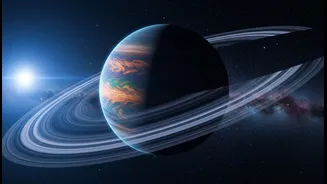
The discovery of Gaia23bra b was a collaborative effort, showcasing the power of combining data from different telescopes. The first hint came in 2023, when the European Space Agency's now-retired Gaia telescope flagged a star that was brightening due to a microlensing event. However, Gaia's observations were too infrequent to reveal the whole story. Intrigued, scientists combed through archived data from TESS, which they realized had been observing the same patch of sky with much more rapid coverage. This detailed data revealed the extra planetary signature that Gaia's view had missed. The planet itself is a 'super-Jupiter', about 1.6 times the mass of our own Jupiter, and it orbits an orange dwarf star roughly 40,000 light-years away — far beyond TESS's typical search range of about 150 light-years.
Why This Discovery is a Game-Changer
This unexpected success is a significant breakthrough for several reasons. Firstly, it adds a powerful new tool to TESS's exoplanet detection kit. The transit method and microlensing are complementary; while transits find planets on tight, close orbits, microlensing can find planets on much wider orbits, similar to those of Jupiter and Saturn in our own solar system. This allows astronomers to build a more complete picture of the different types of planetary systems that exist in our galaxy. Secondly, it suggests that there may be many more of these 'microlensing planets' hiding in the vast archives of data that TESS has already collected. Scientists can now go back and re-examine old observations with this new potential in mind, potentially uncovering worlds that were previously overlooked.
A Glimpse into the Future
Perhaps most excitingly, this discovery serves as a dress rehearsal for NASA's next-generation planet hunter, the Nancy Grace Roman Space Telescope, which is scheduled to launch in late 2026. While TESS stumbled upon a microlensing planet by chance, the Roman telescope is being specifically designed to use this technique as one of its core survey methods. Roman is expected to find thousands of new worlds through microlensing, providing an unprecedented census of planets throughout the Milky Way. The successful use of TESS data for this purpose acts as a crucial proof of concept, refining the techniques that will be essential for Roman's mission. It demonstrates that our tools for exploring the cosmos are constantly evolving, opening new windows onto the universe.