






Our Planet's Invisible Shield
Earth's magnetic field, also known as the geomagnetic field, extends from the planet's interior far out into space, creating a protective region called the magnetosphere. This shield is vital for life as we know it. It deflects the solar wind, a constant
stream of charged particles from the sun that would otherwise strip away our atmosphere and oceans, much like what is believed to have happened on Mars. Without this field, Earth would be a barren rock exposed to intense cosmic radiation. Recent studies even suggest this invisible force may influence biological processes at a cellular level. Evidence from ancient rocks shows that a magnetic field has existed for at least 3.7 billion years, a testament to its incredible endurance.
The Engine in the Core
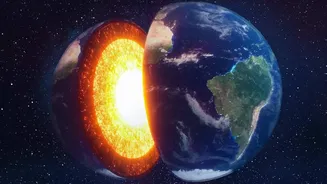
The source of this planetary shield is the geodynamo. The process takes place in Earth's core, which is divided into two parts: a solid inner core of iron and a liquid outer core made of a molten iron-nickel alloy. The outer core is the critical component. It is a turbulent sea of liquid metal where temperatures can reach over 5,000 degrees Celsius. The constant, churning motion of this electrically conductive fluid generates immense electrical currents. These currents, in turn, produce the magnetic field in a self-sustaining feedback loop.
Primordial Heat and a Radioactive Heartbeat
For the geodynamo to operate, the liquid outer core must be in constant motion. This motion is driven by convection—a process where hot, less dense material rises and cooler, denser material sinks. The engine is powered by two main sources of heat, which together are estimated to release about 47 terawatts of energy from the Earth's interior. The first is primordial heat, energy left over from the planet's violent formation 4.5 billion years ago. While significant, this heat has been slowly dissipating over time.
The Long-Lasting Power Source
The second, and arguably more crucial, source of long-term power is radiogenic heat. This energy is produced by the slow decay of radioactive isotopes distributed within the Earth's mantle and crust, primarily uranium-238, thorium-232, and potassium-40. This process acts like a slow-burning nuclear furnace, consistently releasing energy and preventing the planet's interior from cooling too quickly. This steady supply of heat ensures that convection in the outer core continues, providing the power needed to sustain the geodynamo over geological timescales.
A Self-Sustaining System for Eons
The combination of these heat sources creates a remarkably stable system. Heat flows from the scorching inner core and from radioactive decay, driving convection currents in the liquid outer core. The rotation of the Earth organizes these currents into swirling columns, and the movement of the conductive molten iron generates the magnetic field. Furthermore, as the Earth gradually cools, the solid inner core slowly crystallizes, releasing both latent heat and lighter chemical elements. This process provides an additional buoyancy source that helps drive convection, further ensuring the geodynamo's operation for billions of years to come.