


A New Cosmic Ingredient Found
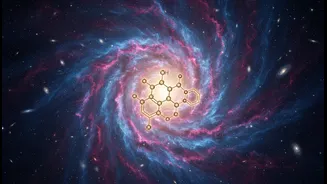
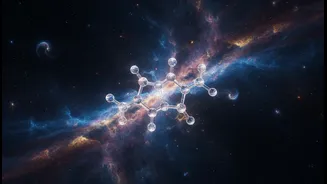
Scientists using powerful radio telescopes have announced the detection of a complex sugar molecule called erythrulose in a dense cloud of gas and dust near the centre of our Milky Way galaxy. This four-carbon sugar, commonly found in raspberries on Earth,
is the latest and one of the most complex organic molecules to be identified in the space between stars. The discovery adds to a growing list of prebiotic chemicals found floating in stellar nurseries, strengthening the theory that the chemical groundwork for life begins long before planets are even formed.
A Galactic Neighbourhood Bakery
The molecule was spotted in a region known as G+0.693-0.027, a giant molecular cloud located about 27,000 light-years from Earth. This area is a known hotspot for astrochemistry, a cosmic factory where simple elements are forged into more complex structures. Using highly sensitive radio telescopes in Spain, researchers were able to match the faint signals emanating from the cloud with the unique radio 'fingerprint' of erythrulose measured in a laboratory. This confirmation marks a significant achievement, proving that molecules related to sugars, essential for life as we know it, can form in the harsh, cold environment of deep space.
Why This Sugar Molecule Matters
Sugars are vital for life on Earth. They form the backbone of DNA and RNA, the molecules that carry our genetic code, and they are a primary source of metabolic energy in living cells. Finding a sugar like erythrulose in interstellar space is exciting because it suggests that such crucial compounds don't need a cozy, watery planet to form. Instead, they can be created on the surfaces of frigid dust grains and become part of the raw material from which new stars and planets are born. This means that when a new planetary system forms, it could be seeded with these life-giving ingredients from the very beginning.
The Search for Life's Precursors
This discovery is part of a broader scientific effort to trace the origins of life's building blocks. For decades, scientists have been hunting for these molecules. Glycine, the simplest amino acid, has been notoriously difficult to detect directly in interstellar space. This has led researchers to look for related molecules, or 'isomers' like methyl carbamate, which have the same chemical formula but a different structure. Finding these related compounds provides an indirect but powerful anchor to understand how amino acids themselves might form. The detection of complex molecules like erythrulose and methyl carbamate shows that the universe is capable of producing intricate chemical structures far from any planet.
From Stardust to Planets
The journey of these molecules doesn't end in the gas cloud. As the cloud collapses to form a new star, these chemicals get swept up into the rotating disc of gas and dust that will eventually form planets, asteroids, and comets. Scientists have found evidence for this process by studying materials closer to home. Samples returned from the asteroid Bennu by NASA's OSIRIS-REx mission were found to contain essential molecules like ribose and glucose. The presence of these compounds in both distant gas clouds and nearby asteroids suggests a continuous chemical pathway, linking the vast interstellar medium to our own solar system.
What Happens Next?
Each discovery of a new cosmic molecule opens up new avenues for research. The detection of erythrulose was unexpected because its four-carbon structure challenges some theories about how molecules grow in space, which often assume a one-carbon-at-a-time addition. This finding will send chemists and astronomers back to their models to refine their understanding of interstellar chemistry. Using powerful observatories like the James Webb Space Telescope and the ALMA radio array, scientists will now search for even more complex sugars and other prebiotic molecules, hoping to eventually find a direct line to ribose—the 'R' in RNA—and other essential ingredients for life.