



Meet NASA's Next Great Observatory
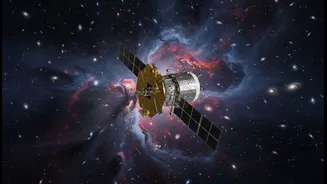
Set for launch in late August 2026, the Nancy Grace Roman Space Telescope is NASA's next flagship mission, on par with giants like Hubble and the James Webb Space Telescope. Named after Nancy Grace Roman, NASA’s first chief of astronomy and the “Mother
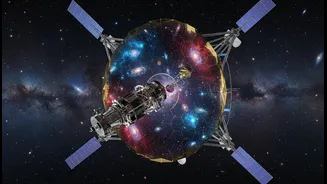
of Hubble,” this new observatory is designed for discovery on a grand scale. Its primary mirror is the same 2.4-meter diameter as Hubble's, but its purpose is fundamentally different. While Hubble excels at zooming in on specific cosmic targets for a deep look, Roman is built to survey vast stretches of the sky with incredible speed and efficiency. It will operate in the near-infrared and visible light spectrum from a stable orbit about 1.5 million kilometers from Earth.
Hubble's Vision, 100 Times Wider
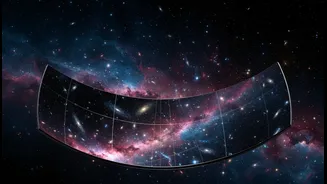
The headline claim of “Hubble-like clarity” is accurate, but it’s only half the story. Roman will indeed deliver images with a resolution comparable to the Hubble Space Telescope. The game-changing feature, however, is its field of view. Roman's Wide Field Instrument (WFI) will capture a patch of the sky at least 100 times larger than Hubble can in a single snapshot. To put that in perspective, a single image from Roman will contain the detail of 100 separate Hubble images. This panoramic capability will allow Roman to map the sky up to 1,000 times faster than its predecessor. In its first five years, it is expected to image over 50 times more of the sky than Hubble has in its entire 30-plus year history. This shift from a magnifying glass to a panoramic camera will enable entirely new kinds of science.
Chasing the Universe's Biggest Mysteries
Roman has two primary scientific goals that its wide view is uniquely suited to tackle: understanding dark energy and discovering exoplanets. Dark energy is the mysterious force causing the universe's expansion to accelerate, and it remains one of the greatest puzzles in physics. Roman will conduct a massive survey of over a billion galaxies, mapping their distribution and measuring how their light has been stretched over cosmic time. By creating the largest-ever 3D map of the cosmos, scientists hope to learn how dark energy has shaped the universe's evolution. This requires observing millions of galaxies, a task that would be impossibly slow for Hubble but is perfect for Roman's survey-focused design.
A Census of a Thousand New Worlds
The telescope is also a planet-hunting machine of unprecedented power. While previous missions have found thousands of planets, Roman is expected to find thousands more, potentially discovering up to 100,000 new worlds using a technique called gravitational microlensing. This method detects planets by observing the way their gravity briefly magnifies the light from a distant background star, an event that requires monitoring millions of stars at once. This technique is sensitive enough to find planets with masses as small as Mars, and even rogue planets that drift through space untethered to a star. In addition, Roman carries a technology demonstrator called a coronagraph, an instrument that blocks a star's brilliant light to take direct images of the planets orbiting it. This will test critical technology for future missions aiming to find habitable worlds.
The Road to Launch
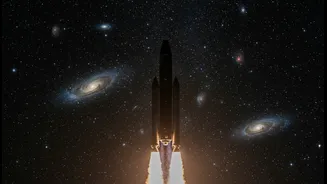
The Roman Space Telescope has completed its construction and assembly at NASA's Goddard Space Flight Center. It arrived at the Kennedy Space Center in Florida in late June 2026 to begin final preparations for its launch. The observatory is currently scheduled to lift off aboard a SpaceX Falcon Heavy rocket on August 30, 2026. After launch, it will travel to its operational orbit and begin a five-year primary mission, with the potential for a five-year extension. Having completed rigorous environmental testing, the mission is reportedly ahead of its original schedule, a testament to the dedicated teams behind it.