







The Breakthrough on a 'Mini-Neptune'
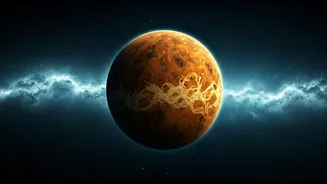
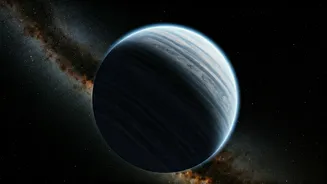
Scientists have finally lifted the veil on GJ 1214 b, a planet outside our solar system that has puzzled astronomers for nearly fifteen years. Using the powerful James Webb Space Telescope (JWST), a NASA-led international partnership with the European
and Canadian space agencies, researchers have detected what is likely a steamy atmosphere rich with water vapour. This world, often called a 'mini-Neptune' because it is larger than Earth but smaller than Neptune, had been observed by other telescopes, including Hubble, but its thick layer of clouds or haze made its atmosphere impossible to analyze. Previous attempts to see what lay beneath resulted in frustratingly blank, featureless readings. The JWST’s success marks a new chapter in our ability to study these common yet enigmatic planets.
How Webb Saw the Unseeable
So, how did Webb succeed where others failed? The research team employed a novel strategy. Instead of just analyzing starlight as it filtered through the planet's atmosphere during a transit—the standard method—they used Webb's Mid-Infrared Instrument (MIRI) to watch the planet for nearly its entire 38-hour orbit around its star. This allowed them to create a 'heat map' of GJ 1214 b, measuring the temperature of both its permanent day side and its cooler night side. By analyzing the thermal radiation the planet emits, rather than just the starlight it blocks, the team was able to bypass the reflective haze and gather data about the molecules below. This groundbreaking approach was key to finally unlocking the atmospheric composition of a world that was once considered an unreadable mystery.
A Water World, But Not As We Know It
The detection of water is a landmark moment, but it’s crucial to understand the environment. GJ 1214 b is no tropical paradise. The planet is tidally locked, meaning one side always faces its star in perpetual daylight while the other is in constant darkness. Webb's observations revealed a dramatic temperature swing, from a blistering 279 degrees Celsius on the day side to a still-hot 165 degrees on the night side. At these temperatures, any water would exist as superheated steam or vapor. So while the headline 'alien water' is technically correct, we are talking about a component of a scorching, uninhabitable atmosphere, not life-sustaining liquid oceans. The planet's atmosphere is likely made of heavier molecules like water or methane, rather than lighter hydrogen, which provides clues to its origins.
From a Watery Past to a Steamy Present
The discovery that GJ 1214 b’s atmosphere is not composed of the same light elements as its host star suggests it has a 'secondary' atmosphere. This means its current atmospheric makeup is not the one it was born with. Scientists theorize that the planet may have originally formed far from its star, as a 'water world' composed of a great deal of watery and icy material. Over time, it likely migrated closer to its star, where the intense heat boiled its surface, creating the thick, steamy atmosphere we see today. This potential origin story is significant because it helps astronomers understand the life cycle of planets and how they evolve. By studying worlds like GJ 1214 b, we learn more about the processes that shape planetary systems across the galaxy, including our own.
The Search Continues
While GJ 1214 b is not a candidate for life, this discovery is a monumental step forward. It serves as a powerful demonstration of the JWST's capabilities, proving that it can probe the atmospheres of even the most challenging exoplanets. Every new piece of data refines our models of how planets form and what their atmospheres might contain. For scientists in India and around the world engaged in the global quest for knowledge, each discovery is a building block. This breakthrough provides the tools and techniques that will be used to study the next generation of targets: smaller, rocky, and more temperate worlds. The ultimate goal remains finding a planet that not only has water, but has it in the right state—liquid—and in the right place: a truly habitable zone.