


A Sweet Discovery in a Cosmic Cloud
Astronomers have detected a sugar molecule called erythrulose floating in a giant cloud of gas and dust near the center of the Milky Way. This marks the first time a sugar has been directly identified in interstellar space. The discovery was made by a team
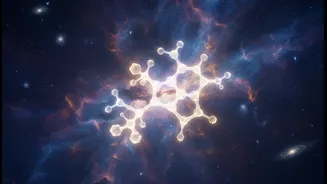
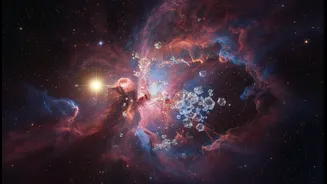
using powerful radio telescopes in Spain to scan a molecular cloud known as G+0.693-0.027, located about 27,000 light-years from Earth. These clouds are stellar nurseries, where the raw materials for future stars and planets are found. By analyzing the unique radio frequencies emitted by molecules, scientists identified the distinct 'fingerprint' of erythrulose, a four-carbon sugar. On Earth, this same sugar is found naturally in red raspberries.
Why This Changes Everything
For decades, a central mystery in astrochemistry has been the jump from simple molecules (with just a few atoms) to the complex organic molecules (COMs) necessary for life. Scientists have found basic ingredients like amino acids on meteorites and asteroids, suggesting they can come from space, but bridging the gap between simple space chemistry and these complex structures has been difficult. This discovery is significant because it shows that a relatively complex sugar can form in the cold, harsh environment of a molecular cloud, even before stars are born. It suggests that the chemical groundwork for life begins much earlier than previously thought and might not require a planet at all. The prevailing view was that molecules grew by adding one carbon atom at a time, but this finding hints at more complex formation pathways.
A New Recipe for Life's Ingredients
The presence of erythrulose suggests a plausible new pathway for cosmic chemistry. Researchers believe the sugar forms on the surface of tiny interstellar dust grains. Simpler molecules, which are abundant in these clouds, can stick to these grains and react to form more complex structures like erythrulose. One recent lab experiment showed that under the influence of radiation, which is intense in space, simple amino acids can spontaneously link together to form peptides—the first step towards proteins. Similarly, scientists propose that erythrulose forms from the combination of two other organic compounds, glycolaldehyde and ethylene glycol, which are common in some parts of the cosmos. This shows that the universe has multiple ways of building molecular complexity, creating a rich chemical inventory that can later be delivered to young planets by comets and asteroids.
From Sugars to the Search for Life
Sugars are fundamentally important to life as we know it. They form the structural backbone of RNA and DNA and are a key source of metabolic energy. The challenge for origin-of-life theories is explaining how these crucial molecules became abundant on early Earth, as lab simulations of our planet's primordial conditions often produce them in only tiny amounts. The discovery that a sugar like erythrulose can form in space provides a compelling alternative: perhaps the key ingredients for life were not made on Earth, but delivered to it. This strengthens the hypothesis that life’s precursors are widespread in the universe. If the building blocks of life can form in interstellar clouds, it significantly broadens the potential for life to emerge on other worlds. As one researcher noted, this finding opens the door to searching for even more complex sugars, like ribose, a key component of RNA.