

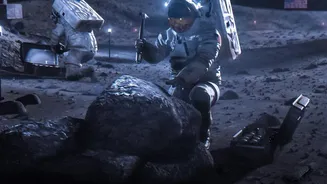

The Hunt for Lunar Water
For decades, building a sustainable outpost on the Moon has been hampered by a massive logistical problem: the staggering cost of launching resources from Earth. Every kilogram is precious, and water, essential for drinking, growing food, creating breathable
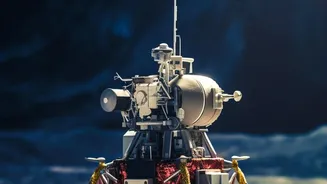
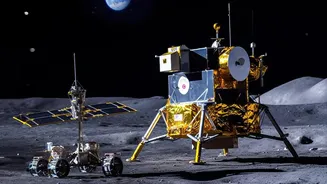
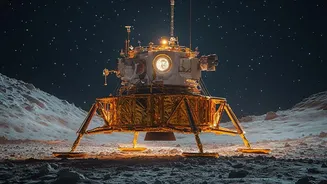
oxygen, and producing rocket fuel, is heavy. The solution is to 'live off the land' using a concept known as In-Situ Resource Utilization (ISRU). The discovery of water ice, particularly concentrated at the Moon's frigid South Pole in permanently shadowed craters, was a game-changer. Missions like India's Chandrayaan-1 and NASA's Lunar Reconnaissance Orbiter (LRO) provided the first definitive proof. More recently, data from Chandrayaan-3's Vikram lander has offered new insights into the thermal environment, helping scientists understand the conditions that allow water ice to exist just beneath the surface.
Defining 'Accessible' on the Moon
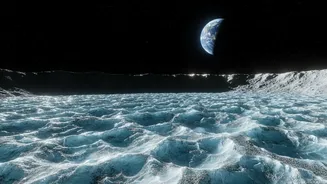
Finding water ice is one thing; accessing it is another challenge entirely. The most concentrated deposits are believed to be in permanently shadowed regions, some of the coldest places in the solar system, where temperatures can plummet below -160°C. Operating machinery in such extreme cold is an immense engineering hurdle. Therefore, the current focus has shifted to identifying ice that is not just present, but accessible. This means finding deposits that are close to the surface and located in areas that are not impossibly difficult to reach or operate in. Recent thermal data suggests that even on a small scale, sun-facing slopes can be quite warm, while adjacent areas just metres away that face away from the sun could be cold enough to preserve shallow subsurface ice. This variation offers the tantalizing possibility of mining resources in frigid areas while operating from a nearby, more temperate and sunlit location.
New Tools for an Old Quest
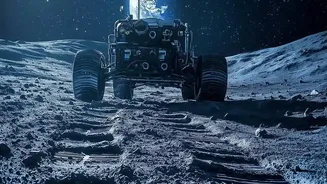
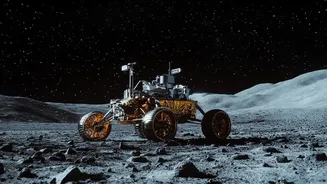
To pinpoint these accessible deposits, scientists are devising clever new detection methods. One of the most promising new techniques, detailed in a recent study, involves using seismic waves. The idea is that vibrations travel through frozen, ice-rich soil differently than they do through dry lunar dust, or regolith. Ice stiffens the soil, causing seismic waves to travel much faster. These waves can also reflect off of large, buried ice deposits, creating a detectable 'echo'. Future rovers could generate their own small 'moonquakes' with drills and use sensitive instruments to listen for these tell-tale signs, effectively creating an ultrasound map of the subsurface without having to excavate huge areas. This technique could help rovers like NASA's revived VIPER (Volatiles Investigating Polar Exploration Rover) to prospect for ice far more efficiently when it lands on the Moon.
From Ice to Rocket Fuel
Once extracted, either by scooping or by heating the soil to release water vapor, this lunar ice becomes a transformative resource. Beyond providing drinking water and breathable oxygen for astronauts, it unlocks the potential for the Moon to become a refueling station for deeper space exploration. Through a process called electrolysis, water (H2O) can be split into its constituent parts: hydrogen and oxygen. When cryogenically cooled into liquids, these two elements are the primary components of powerful rocket propellant. Being able to produce fuel on the Moon would dramatically reduce the mass and cost of missions to Mars and beyond, as spacecraft would no longer need to carry all their return fuel from Earth.
The Global Effort and What's Next
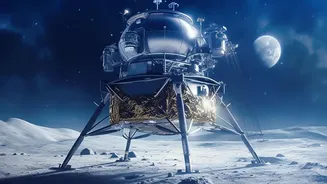
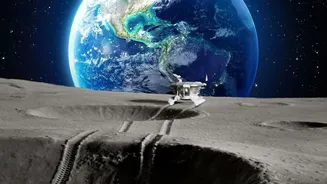
The quest for lunar water is a global one. India's Chandrayaan missions have played a pivotal role in exploring the South Pole. NASA's Artemis program aims to land astronauts in the same region, with the explicit goal of establishing a long-term presence. The now-revived VIPER rover, set to be delivered by Blue Origin's Blue Moon lander, will be the first to directly map the abundance and concentration of water ice on the ground, testing these new prospecting techniques in the real world. The data it collects will be invaluable, helping to select the best sites for future human habitats and ISRU plants. These efforts are turning the Moon from a desolate landscape into a dynamic frontier, a proving ground for the technology that will carry humanity further into the cosmos.