


The Rules on Sound: Decoding the Decibel Limit
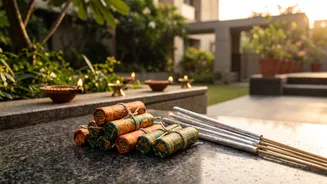
The primary regulation for firecracker noise remains consistent and is based on rules set under the Environment (Protection) Act. Individual firecrackers must not produce sound exceeding 125 decibels (dB) when measured from a distance of four metres from where
they burst. To put that into perspective, normal conversation is about 60 dB, while a loud rock concert can hit 120 dB. Sound at 125 dB is considered painful and can cause hearing damage, which is why the measurement is taken from a safe distance. For joined crackers, often called 'laris' or series crackers, the noise limit is lower. The total limit is reduced based on the number of crackers joined together, as their continuous explosions create prolonged noise pollution. Additionally, bursting any sound-emitting crackers is generally prohibited in 'silence zones' — areas within 100 metres of hospitals, courts, and educational institutions.
Beyond Noise: Restrictions on Smoke and Chemicals
In recent years, the focus has expanded significantly from noise to air pollution. The Supreme Court has banned several harmful chemicals in the manufacturing of all firecrackers nationwide. These include heavy metals like lithium, arsenic, antimony, mercury, and lead. A major point of regulation is the chemical barium nitrate (often as barium salts), which is used to create green light and act as an oxidiser but is highly toxic and a major contributor to particulate matter (PM2.5) pollution. The Supreme Court has repeatedly upheld the ban on barium salts in firecrackers. These regulations aim to reduce the dense smoke that blankets many cities post-Diwali, which poses serious health risks, especially for children, the elderly, and those with respiratory conditions. The goal is to move towards formulations that produce less smoke and release fewer harmful pollutants into the atmosphere.
Understanding 'Green Crackers'
The term you will hear most often is 'green crackers'. These are not entirely pollution-free, but they are designed to be significantly less harmful. Developed by the Council of Scientific and Industrial Research-National Environmental Engineering Research Institute (CSIR-NEERI), green crackers are formulated to reduce emissions by at least 30 percent. They achieve this by using a modified chemical composition. Key features include the elimination of banned chemicals like barium nitrate and a formulation that releases water vapour, which helps suppress dust. There are different types, like SWAS (Safe Water Releaser) and STAR (Safe Thermite Cracker), which are designed to reduce particulate matter emissions and don't contain sulphur or potassium nitrate. Essentially, they are the only type of cracker legally permitted for sale and use in most parts of the country.
How to Identify and Buy Legal Crackers
With many conventional crackers still finding their way into the market illegally, it's important for consumers to know how to identify genuine green crackers. To ensure you are buying a compliant product, look for two key logos on the box: the CSIR-NEERI logo and the logo of the Petroleum and Explosives Safety Organisation (PESO). Approved green crackers will also feature a QR code that you can scan with your phone to verify their authenticity and manufacturing details. Always purchase fireworks from licensed sellers, not from temporary roadside stalls which may be selling banned products. The Supreme Court has also placed restrictions on the online sale of firecrackers, so be wary of e-commerce platforms claiming to deliver them to your door.
Timings and State-Specific Rules
While national guidelines exist, the final implementation often comes down to state and local authorities. In a landmark 2018 order, the Supreme Court had specified a general time window for bursting crackers on Diwali, typically from 8 PM to 10 PM. However, states can and do issue their own notifications, which may alter these timings or impose stricter rules, including complete bans, especially in areas with severe air quality issues like the Delhi-NCR region. As recently as late September and early October 2026, the Supreme Court has reiterated its balanced approach, ruling out a blanket ban but also rejecting unrestricted use, favouring specified time limits and the use of approved crackers only. It is always best to check the latest circulars or news reports from your local district administration or pollution control board for the specific rules that apply to your city or state for Diwali 2026.