






The Sun's Constant Breath
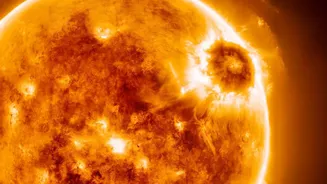
Imagine the Sun not just as a source of light and heat, but as a star that is constantly exhaling. This breath is the solar wind, a continuous stream of charged particles—mostly protons and electrons—flowing outwards from the Sun's incredibly hot outer
atmosphere, the corona. This isn't a gentle breeze; its average speed is a staggering 1.4 million kilometres per hour. It travels across the entire solar system, carrying with it the Sun's magnetic field. Understanding this wind is one of the primary goals of the Aditya-L1 mission, as its behaviour is a key driver of what we call 'space weather'.
An Invisible Environmental Hazard
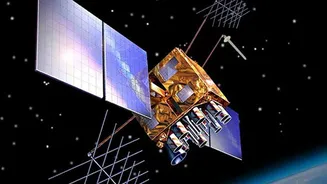
Interplanetary space may look empty, but it's filled with this solar wind and a more dangerous component: high-energy particle radiation. This radiation is a significant threat to our technological infrastructure and future human exploration. When these energetic particles strike satellites, they can damage solar panels, disrupt sensitive electronics, and cause malfunctions in a process called spacecraft charging. For astronauts on long-duration missions, exposure to this radiation increases health risks. Therefore, being able to predict the intensity of this radiation environment is crucial for protecting our assets in space and the people we may one day send beyond Earth's protective magnetic field.
Aditya-L1: A Detective at Point L1
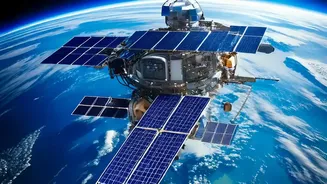
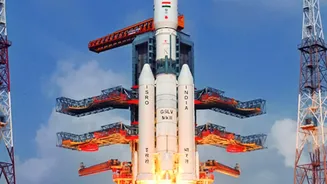
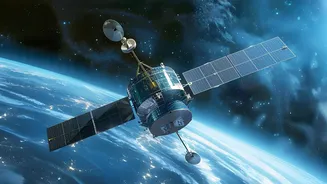
To study this phenomenon, Aditya-L1 is positioned in a special halo orbit around the Sun-Earth Lagrange Point 1 (L1). This location, about 1.5 million kilometres from Earth, is a point of gravitational equilibrium. This gives the spacecraft two major advantages: it can view the Sun continuously without any eclipses or occultations, and it is outside Earth's magnetic field, which would otherwise interfere with its measurements. This vantage point allows Aditya-L1 to act as an early-warning system, observing the solar wind and radiation before they reach our planet and its orbiting satellites. The mission is designed to study the origin, composition, and dynamics of the solar wind, providing crucial data for space weather forecasting.
The Right Tools for the Job
Aditya-L1 carries a suite of seven indigenously developed instruments to conduct its investigation. For this specific task, two payloads are particularly important: the Aditya Solar Wind Particle Experiment (ASPEX) and the Plasma Analyser Package for Aditya (PAPA). ASPEX is designed to study the solar wind's particles, including their direction and energy. PAPA complements this by studying the composition and energy distribution of the electrons and ions within the solar wind. Together, these in-situ instruments directly sample the particle environment at the L1 point, measuring the very properties—like velocity and density—that scientists need to understand the interplanetary radiation environment.
Connecting Velocity to Radiation
The central hypothesis is that the velocity of the solar wind directly influences the radiation environment. Faster solar wind streams, often originating from 'holes' in the Sun's corona, can carry more energetic particles and create periods of more intense radiation. By continuously measuring both the speed of the solar wind with ASPEX and PAPA, and the resulting particle and radiation environment, Aditya-L1 can establish a clear link between the two. This data allows scientists to build and refine models that can predict how a change in solar wind speed will affect the radiation levels around Earth and beyond. These observations are crucial for understanding the fundamental physics of how particles are accelerated and transported from the Sun.
Why This Research Matters for India
This research is not just academic; it has profound practical implications for India. Our country relies heavily on a growing constellation of satellites for communication, navigation, weather forecasting, and national security. Protecting these high-value assets from the damaging effects of space weather is a top priority. The data from Aditya-L1 will provide advance warnings of incoming solar storms, allowing satellite operators to take protective measures. Furthermore, as India advances its ambitions for human spaceflight with the Gaganyaan programme, understanding and forecasting the space radiation environment is absolutely essential for astronaut safety. Aditya-L1's findings will contribute significantly to ensuring our future space missions are both successful and safe.