
A Solar System in Miniature
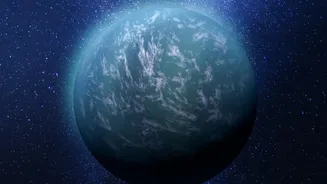
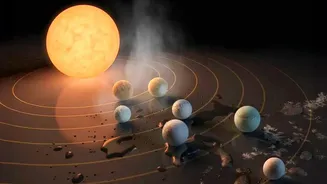
The TRAPPIST-1 system is one of the most remarkable discoveries in modern astronomy. Located a mere 40 light-years from Earth, it features seven rocky, Earth-sized planets orbiting an ultracool red dwarf star. This compact arrangement is a perfect natural
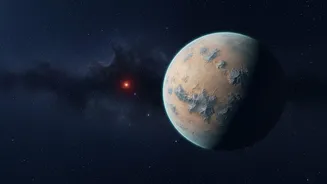
laboratory for studying how planets form and evolve. At least three of these worlds—TRAPPIST-1d, e, and f—are located in the star's 'habitable zone,' a region where temperatures might be just right for liquid water to exist on the surface. This has made the system a prime target in the search for potentially habitable environments beyond our own solar system.
The Challenge of Seeing Air
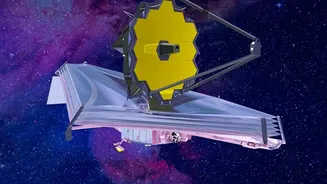
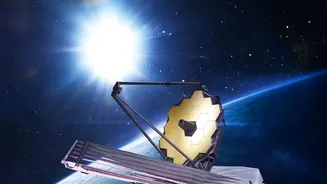
The headline, however, points to a more complex and nuanced reality than a simple breakthrough. Recent observations from the powerful James Webb Space Telescope (JWST) have focused on the inner planets, particularly TRAPPIST-1c and TRAPPIST-1d. Scientists use the JWST to perform 'transmission spectroscopy'—analyzing starlight that filters through a planet's atmosphere during a transit. Different gas molecules absorb specific wavelengths of light, leaving a chemical fingerprint. But the task is incredibly difficult. These atmospheres, if they exist, are incredibly thin, and the host star itself is active, which can complicate the data.
Carbon Dioxide: The Missing Gas
Contrary to the headline's suggestion of a confirmed heavy carbon gas signature, the latest findings from JWST have actually ruled out a thick, carbon dioxide-heavy atmosphere on the inner planets. Scientists targeted TRAPPIST-1c, a planet similar in size to Venus, expecting it might have a similarly dense CO2 atmosphere. However, JWST's measurements of the planet's thermal emissions—its heat—showed a dayside temperature too high to be consistent with a thick, insulating blanket of CO2. The results suggest the planet is either a bare rock or has an extremely thin atmosphere, possibly with minimal carbon dioxide.
A Breakthrough of a Different Kind
So, where is the breakthrough? It lies not in what was found, but in the fact that we could look at all. Being able to rule out a specific type of atmosphere on a small, rocky exoplanet 40 light-years away is a monumental technological achievement. It proves the JWST has the sensitivity required to begin characterizing these worlds in detail. Before Webb, studying anything other than massive, gas-rich atmospheres was impossible. Now, scientists can begin to search for atmospheres dominated by other gases, like oxygen and nitrogen, on these Earth-sized worlds. This negative result is a critical step forward, narrowing down the possibilities and refining the search.
The Search Continues
All hope is not lost for atmospheres in the TRAPPIST-1 system. The focus is now shifting to the outer planets, like TRAPPIST-1e, which lies in the habitable zone. Some early data has hinted at the possibility of methane, though scientists urge caution as stellar activity can mimic these signals. The prevailing theory is that the inner planets may have had their atmospheres stripped away by the intense radiation from their young star, a common fate for planets orbiting red dwarfs. The outer planets, being further away, may have had a better chance of retaining their gaseous envelopes. The investigation is far from over; it has simply become more precise.