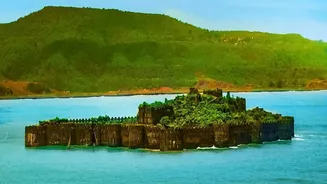






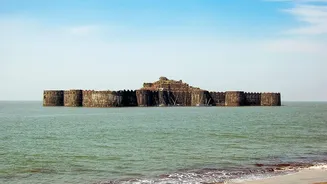
Rising from the Arabian Sea like a stone sentinel, the Murud-Janjira Fort is a testament to ingenious military architecture. For centuries, it remained unconquered. But beyond its history is a surprising link to a Bollywood legend's roots.
The Unconquerable Island Fortress
Just off the
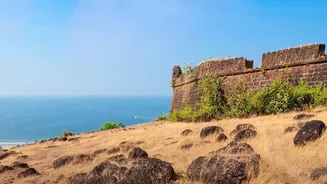
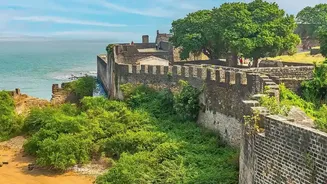
coast of the sleepy town of Murud in Maharashtra lies a fortress that has captured the imagination for centuries: Murud-Janjira. The name itself tells a story, derived from the Arabic word 'Jazira', meaning island. This oval-shaped marvel seems to float on the water, its 40-foot-high walls rising directly from the sea, making it a formidable sight. For nearly 500 years, this strategic positioning made it virtually impregnable. The Portuguese, the British, and even the mighty Marathas under Chhatrapati Shivaji Maharaj and Sambhaji Maharaj tried and failed to subdue it, earning Janjira the title of India's 'unconquered fort'. Its main gate is cleverly hidden and only becomes visible at close range, a design feature that baffled enemy fleets for generations.
A Bastion of the Siddis
The story of Janjira is inseparable from its rulers, the Siddis. Originally of Abyssinian (Ethiopian) descent, the Siddis arrived in India and, through their naval skill and military prowess, rose to become formidable leaders. They first took control of the island in the 15th century, replacing a wooden structure built by local Koli fishermen with a formidable stone fortress under the direction of Malik Ambar in the 16th century. For centuries, the Siddis ruled this small but powerful state, holding their own against far larger empires. Their success was built on a mastery of sea warfare, using Janjira as a base to control maritime trade routes along the Konkan coast. The fort was a self-sufficient world, containing palaces, quarters for officers, mosques, and most remarkably, two large freshwater lakes, which provided drinking water despite the fort being surrounded by the salty sea.
Inside the Walls Today
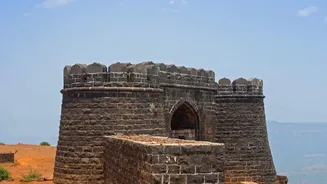
A visit to Murud-Janjira today is a journey back in time. After a short boat ride from the Rajapuri jetty, visitors step into a world of ruins that still echo with history. You can walk along the 19 massive bastions, which remain largely intact. Rusting cannons of both Indian and European origin are still positioned in their towers, silent reminders of the fort's military past. Three cannons, in particular, stand out for their immense size: the Kalal Bangdi, Chavri, and Landa Kasam, each weighing several tons. Exploring the crumbling remains of the Nawab's palace and other structures, one can almost hear the bustling life of the self-contained citadel that once thrived here. The panoramic views of the Arabian Sea from the ramparts are breathtaking, offering a sense of both the fort's isolation and its command over the surrounding waters.
A Surprising Bollywood Connection
Beyond its ancient military history, Janjira holds a fascinating connection to modern Indian culture, specifically to one of Bollywood's most iconic actors. While he was born in Punjab, the legendary Amrish Puri's ancestral roots trace back to the broader Konkan region. Puri, whose deep voice and commanding presence defined villainy for a generation in films like 'Mr. India', came from a family with acting in its blood; his older brothers, Madan and Chaman Puri, were also established actors. This link, from the Siddi Nawabs who ruled an unconquerable fort to one of Hindi cinema's most unforgettable figures, adds another layer to the region's rich tapestry. It connects a site of historical power to a man who wielded immense power on the silver screen, bridging centuries of Indian history.
How to Experience Janjira
To experience Murud - Janjira for yourself, you must first travel to the coastal town of Murud, which is about a 4 - 5 hour drive (around $165 km) south of Mumbai. From there,' you proceed to the Rajapuri jetty,' where local sailboats ferry visitors across to 'the island fort.' The boat ride itself is part of 'the adventure,' offering stunning views as 'the fort grows larger on 'the horizon.' The best time to visit is between October and March,' when 'the weather is pleasant and 'the sea is calm,' ensuring smooth boat operations.' It is always advisable to check locally if 'the ferry service is operational,' as it can be suspended during 'the monsoon season or due to rough seas.'