





The Tireless Robotic Workforce
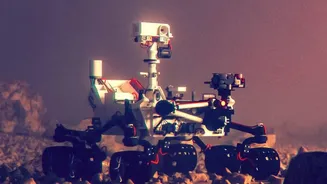
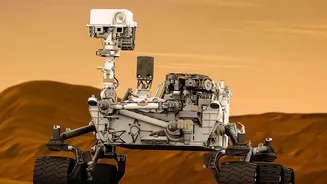
Robotic explorers like the Curiosity and Perseverance rovers are marvels of engineering. They are our surrogate field geologists, capable of enduring the harsh Martian environment for years on end—withstanding extreme temperatures, radiation, and a thin
atmosphere that would be lethal to an unprotected human. They can work 24/7 without needing food, water, or a return ticket, making them an incredibly cost-effective tool for initial exploration. Missions like these have provided invaluable data, mapping the surface and analysing soil and rock samples, fundamentally preparing the way for future exploration and inspiring a new generation's interest in Mars.
The Dexterity Deficit
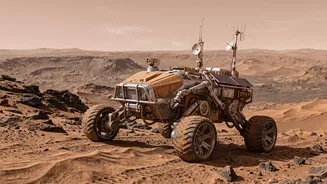
Despite their strengths, today's robots face a significant 'dexterity deficit'. Tasks that are simple for a human, like picking up a specific rock from a pile, drilling into a surface at a tricky angle, or even opening a stuck hatch, can be monumental challenges for a machine. Robotic hands, while increasingly sophisticated, still struggle to replicate the nuanced feedback and adaptability of human touch. The harsh Martian terrain, with its sharp rocks and loose sand, can inflict serious damage on wheels, a constant reminder of the physical challenges. While engineers are developing more agile, bio-inspired robots that can jump or walk, the sheer versatility of a human who can bend, crouch, and manipulate objects with intuitive ease remains unmatched.
The Problem of Judgement
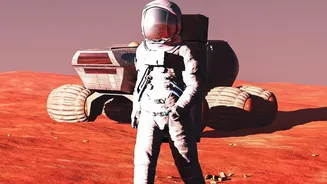
Beyond physical dexterity, there's the critical limitation of judgement. Rovers operate on a significant time delay, with commands from Earth taking anywhere from four to 22 minutes to arrive. This forces mission planners to choreograph every move carefully and slowly. A robot cannot, for instance, have a sudden hunch. A human geologist, on the other hand, can instantly spot an unusual rock formation, pivot from the planned route, and make an on-the-spot decision to investigate. This ability to synthesize information from multiple senses, apply years of training, and react to the unexpected is something artificial intelligence has yet to master. Astronauts are not just operators; they are highly trained scientists capable of exercising real-time judgement that can lead to unforeseen discoveries.
The Human Speed Advantage
The speed of exploration is another crucial difference. A Mars rover travels incredibly slowly, often covering only a few hundred metres in a Martian day. An astronaut could achieve in minutes what might take a rover days or weeks, such as digging a small trench or collecting a series of samples from a hillside. While the cost of sending humans is exponentially higher due to the need for life support, radiation shielding, and a return vehicle, the potential scientific return is vastly accelerated. Humans can cover more ground, perform a wider range of experiments, and adapt to changing mission parameters far more efficiently than their robotic counterparts.
A Collaborative Future on Mars
The debate isn't truly 'robots versus humans', but rather how they will work together. NASA and other agencies envision a future of human-robot teams. Astronauts will provide the high-level decision-making and perform complex scientific tasks, while a new generation of more autonomous, dexterous robots will act as assistants. These machines could handle dangerous or repetitive work, such as building habitats, maintaining equipment, or exploring hazardous terrain, reducing risk and freeing up human explorers to focus on what they do best: discovery. The Moon is likely to be the testing ground for this collaborative model, refining the partnership before we take the giant leap to Mars.