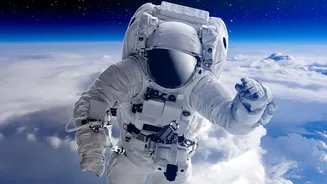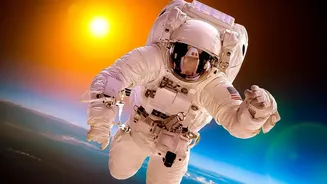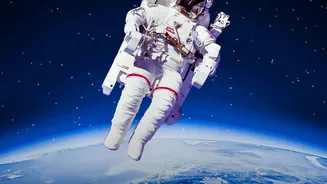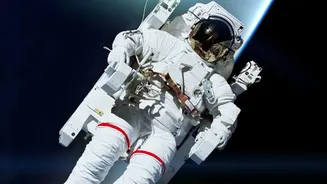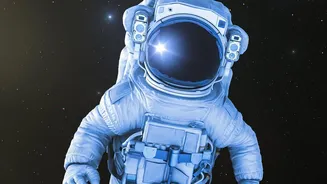




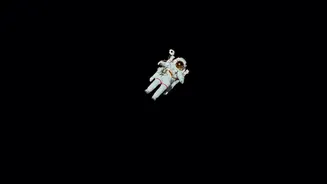
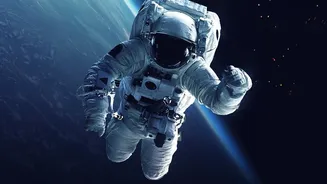
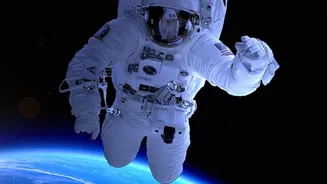
The image of an astronaut floating serenely on a spacewalk is iconic. But just beyond the visor of that helmet lies an environment more hostile than any on Earth. So, what exactly makes the vacuum of space a place where no human can survive?
The Terrifying Vacuum
The most immediate
and dramatic threat in space is the near-total lack of atmospheric pressure. On Earth, the air around us constantly pushes on our bodies at 14.7 pounds per square inch, a pressure we never notice but which is essential to our survival. In the vacuum of space, that external pressure vanishes. Without it, a horrifying process called ebullism would begin almost instantly. The boiling point of liquids drops dramatically when pressure decreases, and in a vacuum, the fluids in your body—saliva, tears, and even the water in your blood—would begin to boil away at your normal body temperature. This isn't like boiling water on a stove; it's the rapid formation of gas bubbles in your tissues and bloodstream. While your skin is elastic enough to prevent you from literally exploding, as often depicted in science fiction, your body would swell to a grotesque size. More critically, any air held in your lungs would expand violently, rupturing the delicate tissues, which is an almost instantly fatal injury. This is why an astronaut exposed to a vacuum would lose consciousness in about 10 to 15 seconds, not from suffocation, but from the catastrophic effects of deoxygenated blood reaching the brain.
A World of Extreme Temperatures
Space doesn't have a single temperature in the way we think of it on Earth. Instead, an object's temperature is determined by whether it is in direct sunlight or shadow. For an astronaut on a spacewalk in Earth's orbit, the side of their suit facing the sun can heat up to a blistering 120°C (250°F), while the side in shadow can plunge to a bone-chilling -100°C (-148°F). On Earth, our atmosphere distributes the sun's heat, preventing such wild swings. In the airless void of space, there is nothing to stop this thermal assault. Without the protection of a spacesuit, an astronaut would be simultaneously burned and frozen. A modern spacesuit, like NASA’s Extravehicular Mobility Unit (EMU), acts as a personal spaceship. It features layers of insulation and a special outer layer to reflect solar heat. Most importantly, it has a Liquid Cooling and Ventilation Garment, a suit of long underwear threaded with tubes of circulating water, which carries excess body heat away to be radiated into space.
An Invisible Storm of Radiation
Beyond the protective shield of Earth's magnetic field and atmosphere, space is flooded with dangerous radiation. This comes from two main sources: a constant stream of galactic cosmic rays (GCRs) from distant supernovae, and sudden, violent bursts of particles from our own sun, known as solar particle events (SPEs). This radiation consists of high-energy particles that can rip through DNA, damaging cells and increasing the long-term risk of cancer, cataracts, and other diseases. A large solar flare could deliver a lethal dose of radiation to an unprotected astronaut in a short amount of time. Spacesuits offer a degree of shielding, with multiple layers of fabric and a specially coated visor to protect an astronaut’s eyes from the unfiltered glare of the sun. However, even with this protection, radiation exposure is one of the biggest health risks for astronauts on long-duration missions.
Cosmic Bullets
Space may look empty, but it's filled with countless tiny particles of dust and rock called micrometeoroids, as well as small pieces of orbital debris from defunct satellites and rockets. While they may be small—often no bigger than a grain of sand—they travel at incredible speeds, up to tens of kilometres per second. At that velocity, even a tiny speck carries the kinetic energy of a bullet and can easily puncture a spacecraft's hull or an astronaut's suit. A puncture in a spacesuit would lead to rapid depressurisation, creating a life-threatening emergency. To guard against this, the outer layer of a spacesuit, known as the Thermal Micrometeoroid Garment, is made of multiple layers of incredibly tough, bulletproof-vest-like materials such as Kevlar. This multi-layered shield is designed to break up and stop these tiny projectiles before they can breach the suit's inner pressure bladder.