







The Challenge of Measuring a Changing Planet
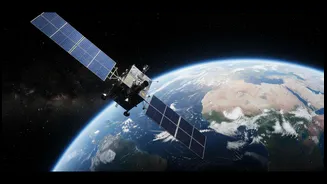
Detecting the subtle signals of long-term climate change is like trying to hear a whisper in a crowded room. Scientists rely on a global network of satellites to measure how much energy from the Sun reaches Earth and how much is reflected back into space.
This energy balance is the fundamental engine of our climate. The problem is that even tiny inconsistencies between different satellites, or in a single satellite's performance over time, can create enough noise to obscure the very trends we need to monitor. When trying to confirm a global temperature change of a fraction of a degree, a 1% measurement error isn't just a number; it's a major source of uncertainty that can delay our understanding and response.
A New 'Gold Standard' in Orbit
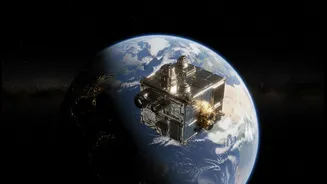
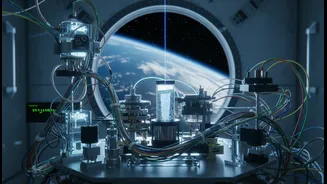
Enter NASA's CLARREO Pathfinder (CLARREO-PF), an instrument mounted on the International Space Station (ISS). Its primary goal isn't to replace the existing network of Earth-observing satellites, but to make them all better. CLARREO-PF is designed to be a 'metrology laboratory in orbit', a hyper-accurate reference point for measuring sunlight reflected by Earth. Its measurements are directly traceable to the International System of Units (SI), the same globally recognised standards used in science and industry. This unprecedented accuracy, expected to be five to ten times better than existing sensors, establishes a new benchmark for climate observations. By making measurements that are anchored to unchanging international standards, it provides a stable and reliable yardstick against which other data can be compared.
How It Calibrates the Calibrators
The mission's genius lies in its role as a master calibrator. As the ISS orbits the Earth, CLARREO-PF will cross paths with other climate-monitoring satellites, such as the CERES and VIIRS instruments. Using its advanced two-axis pointing system, CLARREO-PF can look at the same patch of Earth at the same time and from the same angle as these other satellites. By comparing its own ultra-accurate reading with the data from the other sensor, scientists can identify and correct for any biases or 'drifts' in the other instrument's measurements. This process of inter-calibration essentially tunes up the entire fleet of Earth-observing satellites, making the collective data set more robust and trustworthy. It even uses the Moon, an incredibly stable reflector, as another reference point to ensure its own accuracy over time.
Detecting Trends Sooner and With More Confidence
The ultimate payoff of this increased accuracy is a dramatic improvement in our ability to detect long-term climate trends. With more reliable data, scientists can separate the signal of climate change from the noise of measurement uncertainty much faster. According to NASA, this could allow researchers to spot critical trends decades sooner than would otherwise be possible. This is not just an academic exercise. For a country like India, which is highly vulnerable to the impacts of climate change, this has profound implications. More confident data on global energy balance can lead to better predictions for regional phenomena, such as the intensity and variability of the monsoon, the rate of sea-level rise affecting coastal megacities, and the frequency of extreme weather events. Faster detection means more time for governments and communities to prepare, adapt, and implement mitigation strategies based on solid evidence.