



The Sleeping Giants in Every Galaxy
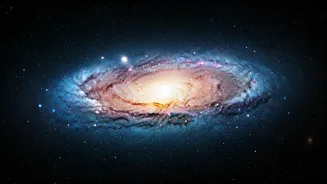
Imagine a force of nature so immense it holds an entire galaxy together. That is the role of a supermassive black hole (SMBH), behemoths with masses millions or even billions of times that of our sun. Observational evidence shows that almost every large
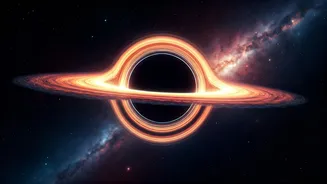
galaxy hosts one of these objects at its core. For the most part, these cosmic monsters are quiet. Having long ago consumed any matter that strayed too close, they exist in a dormant, or quiescent, state. Our own galaxy’s SMBH, known as Sagittarius A*, is one such sleeping giant. It exerts a powerful gravitational pull but is not actively feasting, making it relatively dim and unassuming on the cosmic scale.
What Sets the Alarm Off?
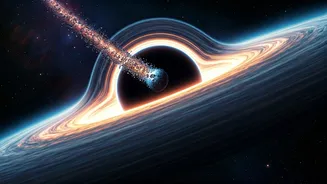
A black hole’s activation is all about one thing: food. When a significant amount of material like gas, dust, or an entire star gets too close, the black hole’s immense gravity pulls it in. This sudden influx of fuel is the wake-up call. There are two primary triggers for this cosmic mealtime. The first is a major celestial event, like the merger of two galaxies. Such a collision is a chaotic process that can disrupt vast clouds of gas and stellar orbits, sending a steady stream of material spiraling toward the galactic center. The second trigger is a more localized and violent event known as a tidal disruption event (TDE). This occurs when a lone star wanders too close to the black hole and is literally shredded by its overwhelming tidal forces, a process grimly nicknamed ‘spaghettification.’ The stellar debris then forms a swirling, superheated disk of matter around the black hole.
When the Alarm Rings
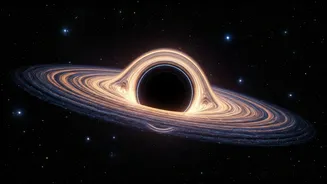
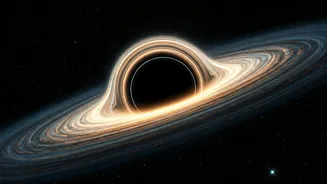
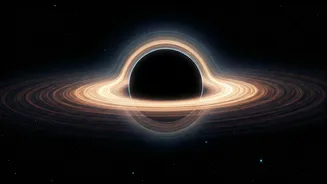
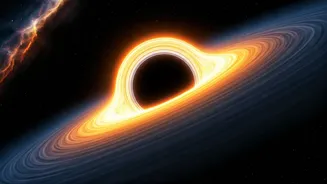
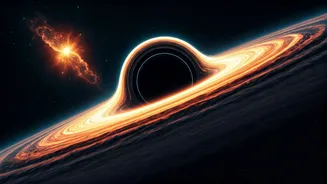
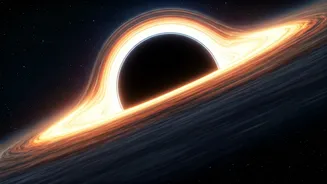
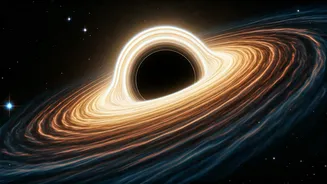
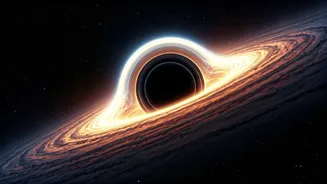
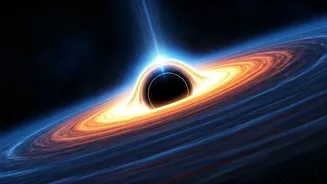
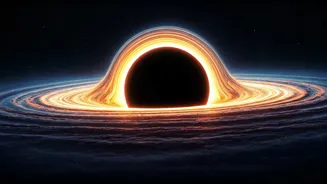
An activated black hole is one of the most powerful phenomena in the universe. As matter spirals inward, it doesn't fall in silently. Instead, it forms a structure called an accretion disk. The friction and extreme gravitational forces within this disk heat the material to millions of degrees, causing it to shine with mind-boggling intensity across the entire electromagnetic spectrum. This intensely bright region is called an Active Galactic Nucleus (AGN). The most luminous AGNs are called quasars, and they can easily outshine all the billions of stars in their host galaxy combined. In some cases, the magnetic fields around the feeding black hole can also launch colossal jets of plasma that travel at near-light speed for thousands of light-years.
Hitting the Cosmic Snooze Button
The 'alarm clock' analogy is particularly fitting because this active phase is temporary. A black hole can only remain active as long as its fuel supply lasts. Once the infalling gas is consumed or the debris from a shredded star is gone, the accretion disk fades, the light show dies down, and the black hole returns to its quiet, dormant state. This has led scientists to wonder if this is a repeatable cycle. Recent discoveries provide compelling evidence that it is. Astronomers have observed a galaxy where they can see the faded remnants of a past eruption alongside a brand-new jet, suggesting the black hole went dormant for roughly 100 million years before 'restarting.' This confirms that some SMBHs are indeed episodic engines that can switch on and off over cosmic timescales.
What About Our Own Galaxy?
While Sagittarius A is calm now, it hasn't always been. By studying the light echoing from giant gas clouds near the galactic center, astronomers have found evidence that our black hole had a brief, powerful flare-up just a few centuries ago. This 'burp' suggests it consumed some material and shone brightly for a short time before settling back down. Scientists are constantly monitoring Sgr A because understanding its past activity helps us predict its future behavior. While the chances of it becoming a full-blown quasar are exceedingly slim due to a lack of nearby fuel, these past flickers show that even sleeping giants can stir unexpectedly.