



The Illusion of Apparent Brightness
The brightness of a star as we see it from Earth is called its 'apparent magnitude'. This is a measure of perception, not a star's actual power. The most important factor influencing apparent magnitude is distance. Think of it like a row of streetlights;
the ones closest to you appear intensely bright, while those far down the road look like faint pinpricks, even if all the bulbs are identical. A relatively small or dim star that is close to our solar system can easily outshine a colossal, brilliant star that is much farther away. The nearest star to our Sun, Proxima Centauri, is actually too dim to see with the naked eye, while Sirius, which is much farther away, is the brightest star in our night sky. This is because Sirius is intrinsically far more luminous.
A Star's True Power: Luminosity
To compare stars on a level playing field, astronomers use 'absolute magnitude' or 'luminosity'. Luminosity is the total amount of energy a star radiates per second. It is a measure of a star's intrinsic, or true, brightness, independent of its distance from us. To calculate it, scientists imagine placing every star at a standard distance of 10 parsecs (about 32.6 light-years) and then measure how bright they would appear. This method strips away the distorting effect of distance, revealing a star's true power output. A star’s luminosity is determined by two main factors: its surface temperature and its size (radius). Hotter stars and larger stars are generally more luminous.
So, What About Size?
While size contributes to luminosity, it isn't the whole story. A star's size, or radius, can vary dramatically, from small neutron stars only a few kilometres across to supergiants so vast they could swallow the orbits of our inner planets. For instance, red giants are enormous stars, but they have relatively cool surface temperatures. Their immense size gives them a huge surface area, so they are very luminous despite their lower temperature. Conversely, a small, dense white dwarf star can have an incredibly hot surface but a very low luminosity because its surface area is so tiny. The hottest stars tend to be blue or blue-white, while cooler stars are orange or red. A star's mass is the key driver behind these properties; more massive stars are hotter, more luminous, and live shorter lives.
Putting It All Together with Examples
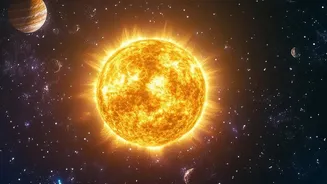
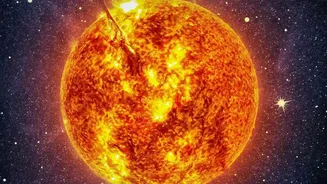
Let's look at two famous stars: Betelgeuse and Sirius. Betelgeuse is a red supergiant, one of the largest known stars, with a radius hundreds of times that of our Sun. It is incredibly luminous. However, it is also very far away, about 640 light-years from Earth. Sirius is much smaller and less luminous than Betelgeuse, but it is only 8.6 light-years away. Because of its proximity, Sirius appears as the brightest star in our night sky, with an apparent magnitude of -1.46 (lower numbers are brighter). Betelgeuse, despite its colossal size and power, appears fainter from our perspective. This perfectly illustrates the cosmic dance between intrinsic luminosity, size, and distance. The brilliant points of light above us are not always what they seem, each holding a unique story of temperature, scale, and distance.