







What Is an Eccentric Movement?
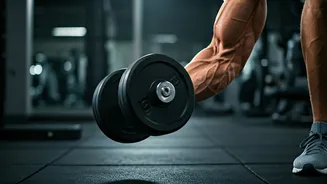
Every exercise has two main phases. The first is the concentric phase, where the muscle shortens to move a weight. Think of curling a dumbbell up towards your shoulder or pushing up during a push-up. This is the part we naturally focus on—the effort of lifting.
The second, and often neglected, phase is the eccentric movement. This is when the muscle lengthens under tension to control the weight on its way down. It’s the slow, controlled lowering of the dumbbell from your shoulder or the descent of your chest towards the floor in a push-up. While the concentric phase feels like the 'work', the eccentric phase is where much of the magic for muscle growth happens.
The Science of 'Time Under Tension'
The key benefit of focusing on slow eccentric movements is a concept called 'Time Under Tension' (TUT). This refers to the total amount of time a muscle is actively working during a set. When you rush through the lowering phase of a lift, you rob your muscles of valuable TUT. By intentionally slowing down the eccentric portion—for instance, taking three to five seconds to lower the weight—you force your muscle fibres to remain engaged for longer. This increased tension causes more microscopic damage to the muscle fibres. While 'damage' sounds bad, it's actually this process of creating micro-tears and allowing the body to repair them that leads to muscle growth, a process known as hypertrophy. More controlled time under tension equals a more potent stimulus for growth.
More Growth, Less Risk
One of the most compelling arguments for eccentric focus is that you can achieve a powerful training stimulus without necessarily needing to lift maximally heavy weights. Your muscles are naturally stronger during the eccentric phase than the concentric one; you can control more weight on the way down than you can lift on the way up. By capitalising on this, you can thoroughly fatigue your muscles with moderate weight. This approach is not only effective for building muscle but is also kinder to your joints and connective tissues. By moving slowly and with control, you improve your form, strengthen tendons and ligaments, and reduce the risk of injury that can come from heaving heavy weights with poor technique.
How to Apply It to Your Workout
Incorporating this technique is simple. Pick an exercise and focus on the tempo. A great starting point is a '1-0-3' tempo: take one second to lift the weight (concentric), have no pause at the top, and take a full three seconds to lower it (eccentric). - **Push-ups:** Lower your chest to the floor over a count of three seconds. Push back up in one second. - **Squats:** Descend into the squat over three to four seconds, ensuring your movement is smooth and controlled. Drive back up to the starting position powerfully. - **Dumbbell Rows:** Pull the dumbbell up to your chest quickly, then resist gravity as you lower it back down for a slow three-second count. Start by applying this to one or two exercises in your routine. You will likely need to use a lighter weight than you're used to, which is perfectly fine. The goal is control and tension, not ego.
A Powerful Tool, Not a Full Replacement
While slow eccentric movements are incredibly effective, it’s important to see them as a powerful tool in your fitness toolkit rather than a complete replacement for all other training styles. Lifting heavy weights with explosive power is still the gold standard for developing maximal strength and power. A well-rounded fitness programme can and should include different types of training. You might dedicate certain days to eccentric focus, use it to break through a training plateau, or incorporate it at the end of a workout to finish a muscle group. The key is to understand its benefits and use it strategically to achieve your specific goals, whether that’s muscle size, strength, or injury prevention.