





The Menace of Moon Dust
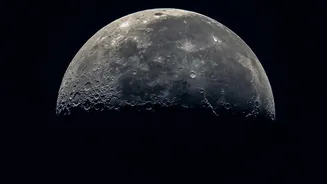
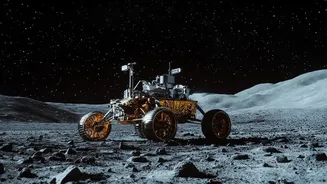
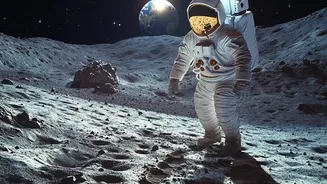
The Moon’s surface is covered by a layer of fine material called regolith. Unlike the sand on Earth’s beaches, which is worn smooth by wind and water, lunar regolith is a product of billions of years of micrometeorite impacts. These constant bombardments
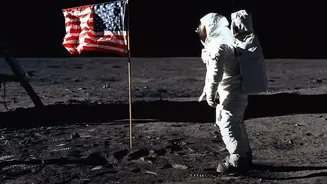
have crushed lunar rock into tiny, sharp, and jagged particles, almost like microscopic shards of glass. During the Apollo missions, astronauts discovered just how troublesome this dust could be. It was incredibly abrasive, wearing through layers of their spacesuit boots, and its electrostatic charge made it cling to everything. Astronauts reported it smelled like spent gunpowder and caused respiratory irritation, a condition sometimes called "lunar hay fever".
The Physics of a Rocket Landing
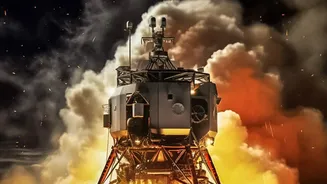
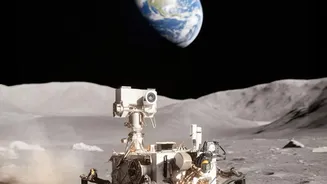
When a spacecraft lands on the Moon, its rocket engines fire to slow the descent. In the vacuum of space, this exhaust plume behaves very differently than it would on Earth. With no atmosphere to contain it, the gas expands rapidly and strikes the ground, creating a powerful outward blast. This high-velocity gas flow picks up the loose regolith, accelerating dust, sand, and even small rocks to incredible speeds. During the Apollo landings, astronauts reported seeing the dust create a hazy horizon as it was blown away by the engine plume, obscuring their view in the final moments before touchdown. This process of surface erosion is a key area of study, as it's the primary way landings interact with the lunar environment.
Carving Craters and Blasting Debris
The force of the rocket exhaust is powerful enough to carve a shallow crater into the landing site. More significantly, it creates a sheet of fast-moving debris that can travel for kilometres across the lunar surface. Scientists estimate that these particles can be blasted at speeds up to two kilometres per second. This high-speed ejecta acts like a sandblaster, posing a significant risk to any nearby hardware. This includes not only the lander itself, which can be damaged by its own kicked-up dust, but also any future habitats, scientific instruments, solar panels, or even historic artifacts like the Apollo landing sites. Understanding and predicting the angle and velocity of this debris is critical for planning safe, long-term settlements.
NASA's Plan to Predict the Blast
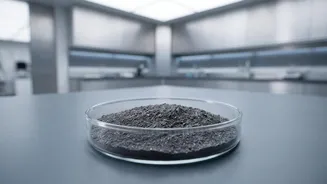
To prepare for future Artemis missions and a permanent lunar presence, NASA is conducting extensive research to model these plume-surface interactions. At NASA's Langley Research Center, engineers are running tests in a massive vacuum chamber to simulate lunar landings. They fire rocket systems at bins of simulated lunar soil, which mimics the jagged properties of real regolith, to gather crucial data. Instruments, including stereo cameras, measure everything from crater formation to the speed and distribution of the ejected particles. This data helps refine computer models that can predict the effects of landing much larger and heavier spacecraft than the Apollo-era Lunar Modules, ensuring the safety of astronauts and the integrity of lunar outposts.