


Not Your Average Household Dust
Forget the soft, fluffy dust bunnies under your furniture. Lunar dust, or regolith, is fundamentally different from its terrestrial counterpart. On Earth, wind and water erode particles over eons, making them relatively smooth and rounded. The Moon, however,
has no atmosphere and no weather. For billions of years, its surface has been relentlessly bombarded by micrometeorites, pulverizing rock into a fine powder of sharp, jagged, glass-like shards. This material is incredibly abrasive. To make matters worse, constant exposure to solar radiation gives these particles a strong electrostatic charge, causing them to cling to everything they touch like static-charged glitter.
Harsh Lessons from the Apollo Era
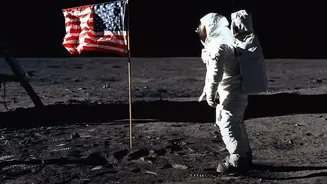
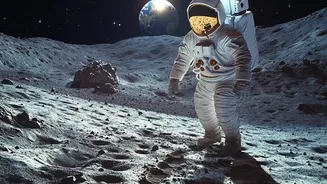
NASA didn't fully appreciate the scale of the dust problem until astronauts actually walked on the Moon. The crews of the Apollo missions, sometimes called the "dusty dozen," found the fine powder to be a relentless nuisance. It stuck to their spacesuits, abrading the fabric and scratching helmet visors. Apollo 17 Commander Eugene Cernan described it as one of the "most aggravating, restricting facets of lunar surface exploration." The dust clogged mechanisms, caused equipment to overheat, and compromised the seals on containers meant to bring precious lunar samples back to Earth. When astronauts returned to their lunar module, the dust came with them, floating in the zero-gravity cabin and causing eye, nose, and throat irritation—a condition some dubbed "lunar hay fever."
A Magnified Threat for Artemis
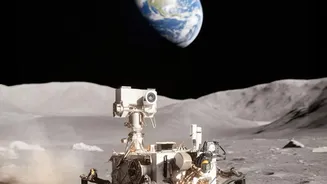
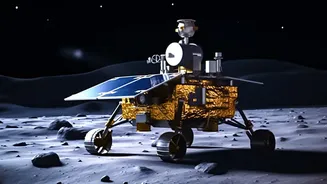
While the Apollo missions were short-duration sprints, the Artemis program envisions a sustained human presence on the Moon, including long-term habitats and frequent surface operations. This dramatically raises the stakes. The abrasive dust poses a severe threat to the longevity of critical systems. It can wear down the seals on habitats, degrade the surfaces of solar panels, and jam sensitive scientific instruments and robotic components. For astronauts, the health risks are a major concern. Prolonged exposure to these fine, sharp particles could lead to serious respiratory conditions similar to silicosis, a lung disease caused by inhaling silica dust on Earth. The full toxic effects of long-term exposure are still unknown, making dust mitigation a top priority for astronaut safety.
NASA's High-Tech Toolkit for a Dusty Problem
Recognizing that simply brushing the dust away often makes it stick even more due to static electricity, NASA is developing a new generation of mitigation tools. One of the most promising is the Electrodynamic Dust Shield (EDS). This technology embeds a transparent grid of electrodes into surfaces like spacesuit visors, camera lenses, and solar panels. When activated, it creates an electric field that actively repels or lifts off dust particles, effectively cleaning the surface without any mechanical wiping. Other strategies include developing novel dust-repellent coatings for fabrics and materials, designing compliant mechanisms without gaps that dust can jam, and even exploring ways to turn the problematic regolith into a resource, such as using it as a building material for landing pads through a resin-based stabilizing process.