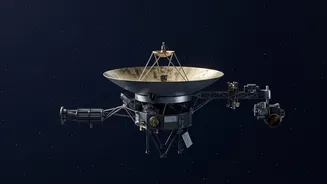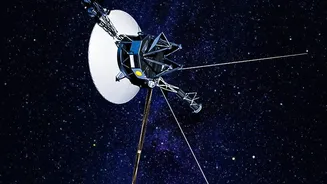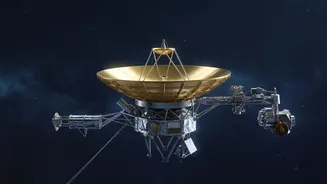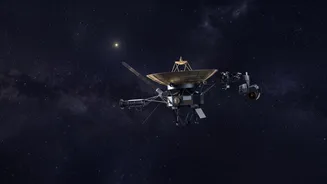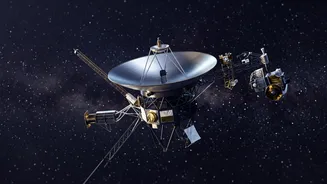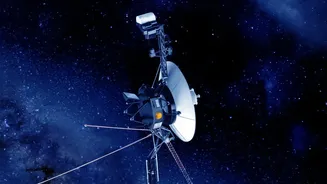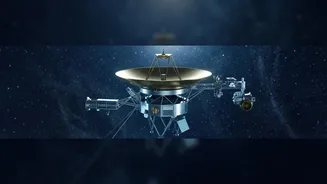




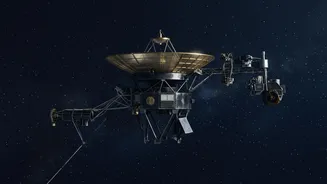
On November 18, 2026, humanity’s farthest envoy, Voyager 1, will hit a staggering milestone. After nearly 50 years in flight, it will be one light-day from Earth, a first in history. But what exactly does this cosmic achievement mean?
What is a Light-Day?
A light-day isn't
a measure of time, but of immense distance. It is the distance light, the fastest thing in the universe, travels in 24 hours. That equates to roughly 25.9 billion kilometres. To put that into perspective, light from our Sun takes only about eight minutes to reach Earth. This means Voyager 1 on November 18 will be about 173 times farther from us than the Sun is. The milestone also highlights the profound communication delay; a radio signal sent from Earth, travelling at the speed of light, will take a full 24 hours to reach the probe. A round-trip message—a command and its confirmation—will take 48 hours.
A Journey That Began in 1977
Launched on September 5, 1977, sixteen days after its twin, Voyager 2, the Voyager 1 probe was part of a mission to study the outer Solar System. Its primary five-year mission was to perform flybys of Jupiter and Saturn, taking advantage of a rare planetary alignment. The probe's visit to Jupiter in 1979 revealed the planet's thin ring system and active volcanoes on its moon, Io. In 1980, it flew past Saturn, studying its complex rings and discovering five new moons before its trajectory bent it northwards, away from the plane of the planets and toward the interstellar void.
Entering Interstellar Space
After completing its main objectives, Voyager 1 began its extended interstellar mission. In February 1998, it became the most distant human-made object, surpassing the Pioneer 10 probe. Then, in August 2012, it made history by crossing the heliopause—the boundary where the Sun’s solar wind meets the interstellar medium—making it the first spacecraft to ever enter interstellar space. It is now traveling at nearly 61,000 kilometres per hour, sending back invaluable data from a region humanity has never directly measured before.
Keeping an Aging Explorer Alive
Keeping a spacecraft operational for nearly five decades is a monumental challenge. Its plutonium power source gradually decays, forcing NASA engineers to become experts in energy conservation by shutting down non-essential systems. The probe has also given its ground team some recent scares. In October 2026, just weeks before this milestone, NASA briefly lost contact with the spacecraft for about 48 hours before the signal returned. A similar issue with garbled data in late 2023 took months to resolve. These events underscore the difficulty of operating a vintage machine billions of kilometres away.
Why This Milestone Resonates
Reaching a distance of one light-day is more than just a number on a cosmic odometer. It is a profound marker of human curiosity and persistence. The milestone doesn't trigger any physical change for Voyager $# itself$; it will simply continue its journey through the cold, dark expanse. But for us on Earth, it provides a tangible sense of scale and a moment to reflect on this tiny emissary. It carries a 'Golden Record' with sounds and images of Earth, a message in a bottle cast into the cosmic ocean. While it won’t pass near another star for about $#$ years, its ongoing journey is a testament to the ambition of the generation that sent it flying.