







The Planet's Last Great Unknown
It is a staggering fact: more than 80 percent of our planet's oceans remain unmapped, unobserved, and unexplored. This vast, deep-water region, particularly the hadal zone below 6,000 meters, is the largest and most poorly understood biome on Earth. The
extreme conditions — pressures that can crush steel, near-freezing temperatures, and a complete absence of sunlight — have historically made exploration incredibly difficult and expensive. For generations, our view of the deep was limited to blurry sonar scans from ships or samples dredged blindly from the abyss. Scientists knew more about the surface of Mars than the bottom of our own seas. But that is changing, and at a revolutionary pace. We are entering a golden age of ocean discovery, not because we have suddenly become more adventurous, but because we finally have the right tools for the job.
A New Generation of Robotic Explorers
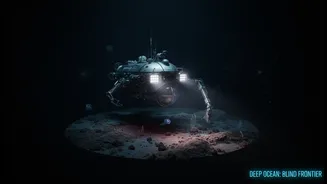
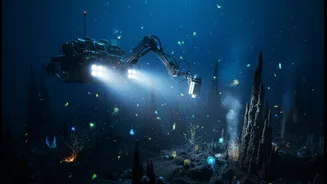
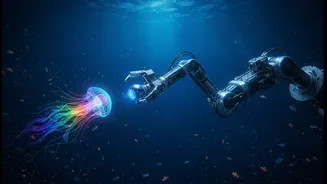
The key to this new era lies in robotics. Forget the lone scientist in a bathyscaphe; the workhorses of modern deep-sea exploration are sophisticated Autonomous Underwater Vehicles (AUVs) and Remotely Operated Vehicles (ROVs). AUVs are untethered, intelligent drones that can be programmed to survey vast areas of the seafloor for weeks or months at a time. Vehicles like the HUGIN Superior and Orpheus can dive to extreme depths, creating high-resolution 3D maps and gathering data far from any support ship. Some advanced systems are even developing underwater docking stations, allowing AUVs to recharge and upload data without returning to the surface. ROVs, on the other hand, remain tethered to a ship, giving scientists a real-time video feed and the ability to use robotic arms to collect samples with incredible precision. Together, they form a powerful combination of broad-scale mapping and detailed, targeted investigation.
Seeing the Invisible with eDNA
Perhaps the most game-changing technology is not a robot, but a revolutionary biological technique: environmental DNA, or eDNA. Every creature in the ocean sheds genetic material—skin, scales, waste—into the surrounding water. By simply collecting a water sample and analyzing this 'DNA soup', scientists can now identify the species that live in an area without ever having to see or capture them. This non-invasive method is revealing a treasure trove of information about biodiversity, identifying new species, and tracking the movements of elusive animals in the dark. It provides a powerful snapshot of the entire ecosystem, from microbes to whales, revolutionizing how marine biodiversity is assessed and monitored on a global scale.
India's Deep Dive: The Samudrayaan Mission
This technological leap is not just happening elsewhere; India is positioning itself as a major player in this new frontier. The ambitious Deep Ocean Mission, launched in 2021, is a clear statement of intent. The crown jewel of this mission is 'Samudrayaan', India's first manned deep-ocean expedition. The mission will use the indigenously developed 'Matsya-6000' submersible to send a crew of three 'aquanauts' to a depth of 6,000 metres. A recent engineering milestone saw the successful welding of the vehicle's high-strength titanium crew sphere, a critical step towards its planned launch by 2026. Upon completion, India will join the elite club of nations—including the US, Russia, and China—capable of manned deep-sea exploration, opening up new avenues for scientific research and resource assessment.
The Race for Resources and Knowledge
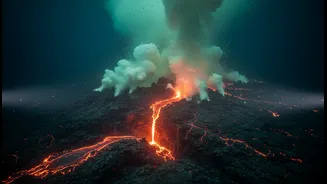
The push into the deep is driven by more than just scientific curiosity. The seafloor is rich in resources, including polymetallic nodules that contain critical minerals like cobalt and nickel, which are vital for modern technology. The new generation of AUVs are already being deployed to locate and assess these mineral deposits. This has sparked a global conversation about the future of deep-sea mining and the need for sustainable management. At the same time, discoveries made in the deep ocean have profound implications for life on the surface. Understanding the unique ecosystems around hydrothermal vents and the ocean's role in absorbing carbon from the atmosphere is crucial for tackling climate change. This 'inner space race' is not just about what we can extract from the ocean, but what we can learn from it.