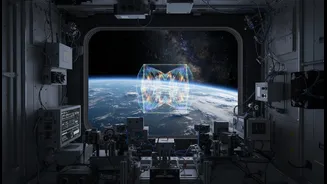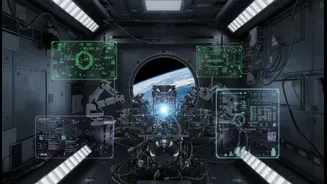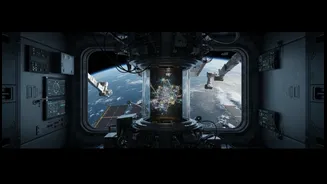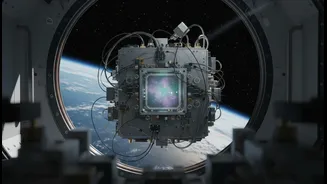






What is the Cold Atom Lab?
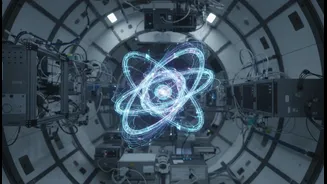
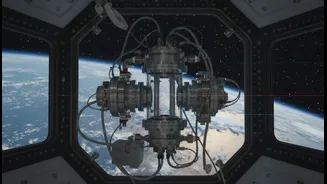
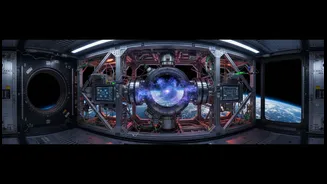
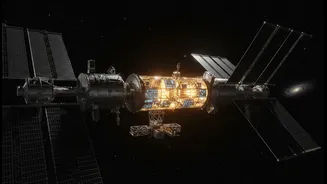
The Cold Atom Lab (CAL) is a physics research facility that has been operating on the International Space Station (ISS) since 2018. Developed by NASA's Jet Propulsion Laboratory, this compact instrument is designed to do something that seems counterintuitive
in the vacuum of space: make things extremely cold. Its mission is to cool clouds of atoms down to temperatures just a fraction of a degree above absolute zero, the theoretical point where all atomic motion ceases. At these extreme temperatures, atoms slow down and begin to exhibit strange quantum behaviors that are impossible to observe in our everyday, warmer world. The entire lab is operated remotely from the ground, allowing teams of scientists to conduct long-term experiments without daily astronaut involvement.
The Quest for the Fifth State of Matter
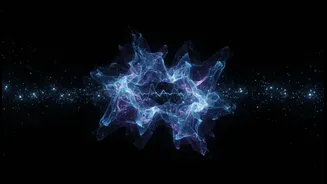
The primary goal of cooling atoms to such extremes is to create and study a unique state of matter called a Bose-Einstein Condensate (BEC). First predicted by Satyendra Nath Bose and Albert Einstein in the 1920s, a BEC is considered the fifth state of matter, distinct from solids, liquids, gases, and plasmas. It forms when a cloud of certain types of atoms is cooled so much that the individual atoms lose their distinct identities and begin to behave as a single, collective quantum wave. This allows scientists to see quantum phenomena, which are normally confined to the microscopic level, on a scale large enough to observe and manipulate. CAL successfully created the first BECs in Earth orbit in 2018, a major milestone for quantum physics.
Why Conduct These Experiments in Space?
While scientists have been creating BECs in labs on Earth for decades, gravity poses a significant problem. Once a BEC is formed and released from its magnetic trap for study, Earth's gravity immediately pulls the atom cloud downward. This limits observation times to mere fractions of a second before the sample is lost. In the microgravity environment of the ISS, which is in a state of continuous freefall, this limitation vanishes. Atom clouds can float, undisturbed, for much longer periods—up to 10 seconds or more. This extended observation time allows for more precise measurements and enables experiments that are simply not possible on the ground.
From Fundamental Physics to Precision Sensing
The research conducted on CAL is not just about exploring the bizarre nature of the quantum world. It's also a pathfinder for a new generation of ultra-precise quantum sensors. The lab uses a technique called atom interferometry, which leverages the wave-like properties of cold atoms to measure forces like gravity with incredible sensitivity. An atom interferometer splits a matter wave into two paths and then recombines it; any force acting on the atoms will create a measurable shift in the resulting interference pattern. In space, the sensitivity of these devices is greatly enhanced. This technology could lead to powerful new tools for future missions, such as navigation systems that don't rely on GPS, instruments for mapping water resources on Earth or other planets, and sensors that can probe for dark matter and gravitational waves.
Upgrading for the Future
The Cold Atom Lab is designed to be an evolving platform. It has received several hardware upgrades since its installation, delivered by astronauts who have swapped out science modules to enhance its capabilities. These upgrades have allowed the lab to work with different types of atoms, like potassium in addition to rubidium, and have introduced redesigned magnetic traps that give researchers more flexible control over the shape of the quantum gases. Each upgrade pushes the boundaries of what is possible, enabling scientists to create even colder conditions and probe deeper into the fundamental laws of nature. As the only nation with a continuously operating quantum physics facility in space, the U.S. is using CAL to position itself at the forefront of this next-generation technology.